

Writing about this subject tends to arrive as either a revolution or a fraud. The official statistics offices have been counting instead, and their numbers describe something narrower and more useful than either story. How AI is changing everyday work, as measured across the EU, the United States and the UK, comes down to a specific set of tasks, a specific set of employers, and one bottleneck that nobody has solved.
Updated October 2026. Figures are from the national and EU statistical releases named in the sources, with their reference periods given.
How many people are actually doing this
Eurostat found that 20.0 per cent of EU enterprises with 10 or more employees used AI technologies in 2025, up 6.5 percentage points from 13.5 per cent in 2024. The spread between member states is enormous: Denmark at 42.0 per cent, Finland at 37.8 and Sweden at 35.0, against Romania at 5.2, Poland at 8.4 and Bulgaria at 8.5. Denmark alone gained 14.5 percentage points in a year.
The US Census Bureau’s Business Trends and Outlook Survey found a similar level. Between mid-December 2025 and early May 2026, between 17 and 20 per cent of US firms reported using AI, with 20 to 23 per cent expecting to within six months. Firms with 250 or more employees reported 37 per cent use, those with 100 to 249 employees 32 per cent, and firms with fewer than 20 employees stayed below 20 per cent with no significant change.
6 shifts in how AI is changing everyday work
- Text work went first. Eurostat’s most common use was analysing written language at 11.8 per cent of enterprises, followed by generating images, video or audio at 9.5, generating written or spoken language at 8.8, and converting speech to machine-readable text at 7.2.
- Language analysis grew fastest. Text analysis rose 4.9 percentage points between 2024 and 2025, more than any other category.
- It is concentrated in large employers. The UK ONS recorded around 49 per cent use among businesses with 250 or more employees; the US figure for firms of that size was 37 per cent.
- And in information-heavy sectors. US use ran at 39.7 per cent in Information and 33.9 per cent in Finance and Insurance against 14 per cent in Retail Trade.
- Headcount has mostly not moved. The ONS reports that most businesses using AI have seen no change in overall workforce headcount so far, with only a small minority of medium-sized businesses reporting reductions.
- The geography is lopsided. A worker in Copenhagen and a worker in Bucharest are not having the same decade. The gap between the highest and lowest EU adoption rates is roughly eightfold.
Tasks change; jobs change more slowly
Read the category lists and a pattern appears. What these systems are being used for is drafting, summarising, translating, transcribing and generating first versions. Those are tasks, and they sit inside jobs that also involve deciding, negotiating, being accountable and knowing which of three plausible answers is the one your organisation can defend. The statistics on headcount are consistent with that: the work is being redistributed inside roles faster than the roles are disappearing.
The UK figures make the same point from the technology side. The most used categories were large language models for generating text and tools for creating visual content, with machine learning for data processing behind them and robotics far back at 2 per cent. The thing spreading through offices is a drafting tool, not an automation programme.
Verification is the actual bottleneck
A drafting tool only saves time if checking the draft costs less than writing it would have. That single comparison explains most of the difference between teams who report real gains and teams who quietly stop. Replying to a routine email is cheap to check, because you can read it in ten seconds and you already know what you meant. A contract clause, a medical summary or a figure that goes into a board paper is expensive to check, because verifying it properly means doing most of the underlying work anyway.
So the useful question for any specific task is not whether a model can do it, but how much the check costs and who is accountable if the check is skipped. Our guide to how to check an AI answer covers the mechanics of that. If you are being sold something more autonomous, what an AI agent is is worth reading first, and prompt engineering matters more than it sounds, because a vague request produces output that is expensive to verify.
What these systems are still reliably poor at
Three weaknesses turn up repeatedly and none of them is fixed by a bigger model. The first is admitting uncertainty: output arrives in the same confident register whether the underlying material was solid or absent. The second is precise recall of specific details, which is exactly what people reach for when they ask for a figure, a date or a citation. The third is any task where a long chain of small steps has to be exactly right, because an early error is carried forward rather than caught.
That is why the adoption statistics look the way they do. The uses that spread fastest are the ones where a human reads the result immediately and would notice a problem: drafting, summarising, transcribing, translating. The uses that have not spread are the ones where nobody would notice until it mattered.
How to judge a product that claims to use AI
- Which task, exactly? If the answer is a category rather than a task, the gain has not been measured.
- What does the check look like? A product that cannot tell you how to verify its output is handing you a liability.
- Where does the data go? The same question you would ask of any supplier processing your records.
- What happens when it is wrong? Not whether, but what the process is when it happens.
- Does it survive the pilot? Adoption statistics count usage, not retention. Measure your own.
Common questions
What share of businesses actually use AI? Eurostat recorded 20.0 per cent of EU enterprises with 10 or more employees in 2025. The US Census Bureau recorded 17 to 20 per cent of firms between December 2025 and May 2026.
Is AI reducing headcount? Not so far in the published data. The UK ONS reports that most businesses using AI have seen no change in overall workforce headcount, with only a small share of medium-sized businesses reporting reductions.
What is AI most commonly used for at work? Analysing written language was the most common use among EU enterprises at 11.8 per cent, followed by generating images, video or audio, generating written or spoken language, and speech-to-text.
Why do small firms lag behind? The size gradient is consistent across all three statistical agencies. In the US, 37 per cent of firms with 250 or more employees reported use against under 20 per cent of firms with fewer than 20 employees.
Where should a team start? With tasks where the output is cheap to verify and the cost of an error is low, and nowhere near tasks where checking the answer costs as much as producing it.
Sources and further reading
Where the figures and rules above come from, so you can check them:
- EU enterprise adoption in 2025 and 2024, country spread and the most common uses: Eurostat, 20% of EU enterprises use AI technologies
- US firm-level adoption by size and sector, December 2025 to May 2026: US Census Bureau, large firms with at least 250 employees biggest AI users
- UK adoption by business size, technology type and the effect on headcount: Office for National Statistics, artificial intelligence in UK businesses
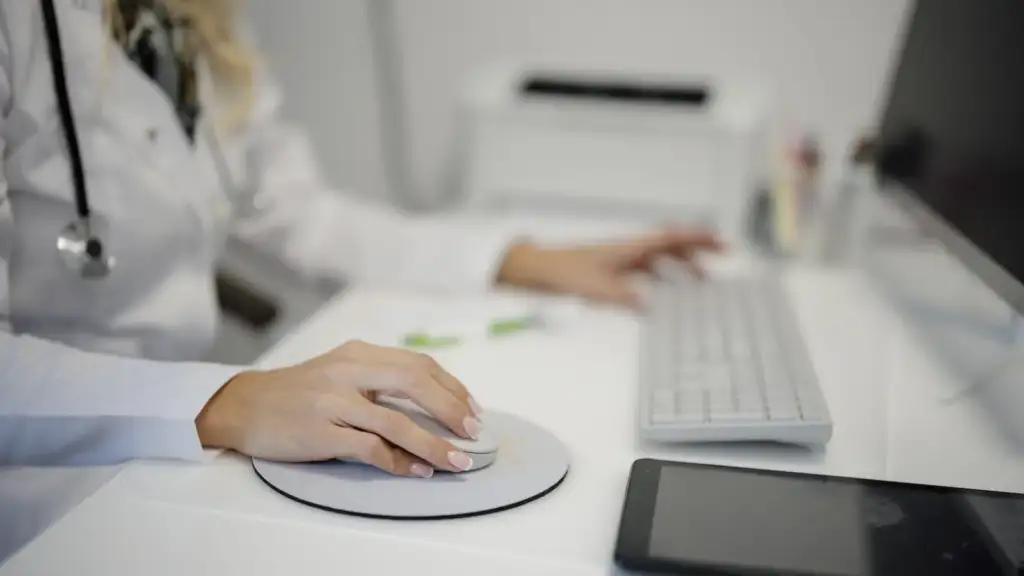
Photo credit: Doctor working at a desk using a computer mouse and keyboard in a medical office setting by Shixart1985, CC BY 2.0, via Wikimedia Commons.

Join the discussion