

Wrist spin was once treated as too expensive for a twenty over innings, and it is now a first-choice weapon in it. The reasons are structural rather than magical, and two of them can be read straight off published documents: the playing conditions decide how many overs anyone can bowl and where the fielders may stand, and biomechanics research has measured what actually leaves a wrist spinner’s hand. Put those together and the modern use of leg spin stops looking like a gamble.
Updated October 2026. Rules are quoted from the ICC Men’s Twenty20 International Playing Conditions effective July 2025, and measured figures from the peer reviewed studies listed in Sources. Domestic competitions use their own variations.
How wrist spin works, and why the hand matters
A wrist spinner imparts spin with the wrist and fingers so that the ball rotates about an axis the batter has to read in flight. Research using an instrumented ball classifies deliveries by that axis rather than by folklore, separating backspin, side spin, top spin and combinations, with named variations including the googly, the flipper and the doosra. The same work reports average angular velocities for individual bowlers ranging from roughly 18 to 37 revolutions per second across deliveries.
A second study, analysing 412 deliveries recorded between 2012 and 2021, gives figures for wrist spinners specifically: spin rates of 26.91, 27.77, 29.62 and 30.70 revolutions per second for its four wrist spin subjects, with a working rule that around 0.3 newton metres of spin torque produces an average of about 30 revolutions per second. Its central finding is about timing rather than strength. Bowlers who converted torque into spin most effectively applied it earlier relative to release and across a wider window, between 0.184 and 0.233 seconds for the best performers against 0.155 to 0.164 seconds for the weaker ones, and did so at smaller peak torques.
That is the mechanical core of the problem for a batter. Revolutions come from a longer, earlier application of torque, not a violent flick at the end, so the cues arrive late and the same action can produce different axes.
What the playing conditions make possible
The ICC Men’s Twenty20 International Playing Conditions effective July 2025 set the frame. Clause 13.6.1 limits each innings to a maximum of 20 overs. Clause 13.9.1 states that no bowler shall bowl more than 4 overs in an innings, and in shortened matches clause 13.9.3 caps a bowler at one fifth of the total overs for innings of at least 10 overs. Clause 28.7.2 makes the first 6 overs the Powerplay, during which clause 28.7.4 permits only two fielders outside the fielding restriction area, a 30 yard or 27.43 metre radius marked from the middle stump at each end. Afterwards clause 28.7.5 allows no more than five outside it.
Three consequences follow directly. First, nobody can be bowled into the ground, so a captain needs four or five credible options rather than two, which creates room for a specialist. Second, once the Powerplay ends there are five fielders available on the boundary, which is exactly the protection a bowler inviting a big shot needs. Third, there is a penalty for slow play: under clause 13.8.2, if the fielding side is not in position to bowl the first ball of the penultimate over by the scheduled cessation time, only four fielders may be outside the circle for the rest of the innings. Spin gets through overs quickly, and that now has a rule attached to it.
6 reasons wrist spin is so hard to face
- The ball turns both ways from the same action. Leg break and googly come out of a similar delivery, so the batter cannot read direction from the arm alone.
- Spin rate is built early. The torque that generates revolutions is applied across a window before release, which gives fewer late visual cues than a flick would.
- The axis changes the bounce as well as the direction. Top spin and side spin behave differently off the pitch, so length judgement is affected and not just line.
- Pace is a choice, not a constant. A slower ball spends longer in the air, which gives the batter more time to see it and the ball more time to deviate.
- The field is set for the shot you want to play. After the Powerplay, five fielders may sit outside the circle, so clearing them is the only way to score quickly.
- The over limit protects the bowler. A maximum of four overs each means a batter rarely gets a long enough look to solve a wrist spinner inside one innings.
The costs teams accept
None of this makes the method free. Variance is the price: an action that depends on a fine release window will sometimes produce a short ball or a leg side wide, and the free hit rules under clause 21.19 make a no ball expensive, with field changes restricted for the free hit delivery. Teams accept that because of where the four overs are spent. Wickets in the middle overs break a chase in a way that a tidy over does not, and a bowler who takes them is worth an occasional costly one.
The selection logic is the same one that governs workload elsewhere in the game. If you have ever wondered why fast bowlers get rested, the answer and this one share a premise: squads are built around which abilities survive a schedule. For the longer format view of the same question, see how a Test match is won from behind and what a team in cricket is for.
Common questions
What is wrist spin? Spin imparted mainly by the wrist and fingers so the ball rotates about a chosen axis, allowing a bowler to turn it in both directions from a similar action. Research classifies the deliveries by spin axis, with named variations including the googly, flipper and doosra.
How fast does a spinning cricket ball rotate? Published measurements with an instrumented ball report average angular velocities of roughly 18 to 37 revolutions per second across deliveries, and a separate study reports 26.91 to 30.70 revolutions per second for its wrist spin subjects.
How many overs can one bowler bowl in a T20 international? Four. Clause 13.9.1 of the ICC Men’s T20I Playing Conditions states that no bowler shall bowl more than 4 overs in an innings, with a one fifth cap in shortened matches of at least 10 overs.
How many fielders can be outside the circle? Two during the first 6 Powerplay overs and no more than five afterwards. If the fielding side is late starting the penultimate over, only four are allowed for the rest of the innings.
Is leg spin riskier than finger spin? It carries more variance, because the release window is finer. Teams accept that in exchange for wickets in the phases that decide matches, and the four over limit means a batter rarely gets long enough to settle against it.
Sources and further reading
Where the figures and rules above come from, so you can check them:
- Innings length, overs per bowler, Powerplay and fielding restrictions, over-rate penalty and free hit: ICC Men’s Twenty20 International Playing Conditions, effective July 2025
- Delivery classification by spin axis and measured angular velocities: Identification of Spin Bowling Deliveries with an Advanced Smart Cricket Ball, Sensors
- Spin rates for wrist spin subjects and the torque timing finding: The Biomechanics of Converting Torque into Spin Rate in Spin Bowlers Analyzed with a Smart Cricket Ball
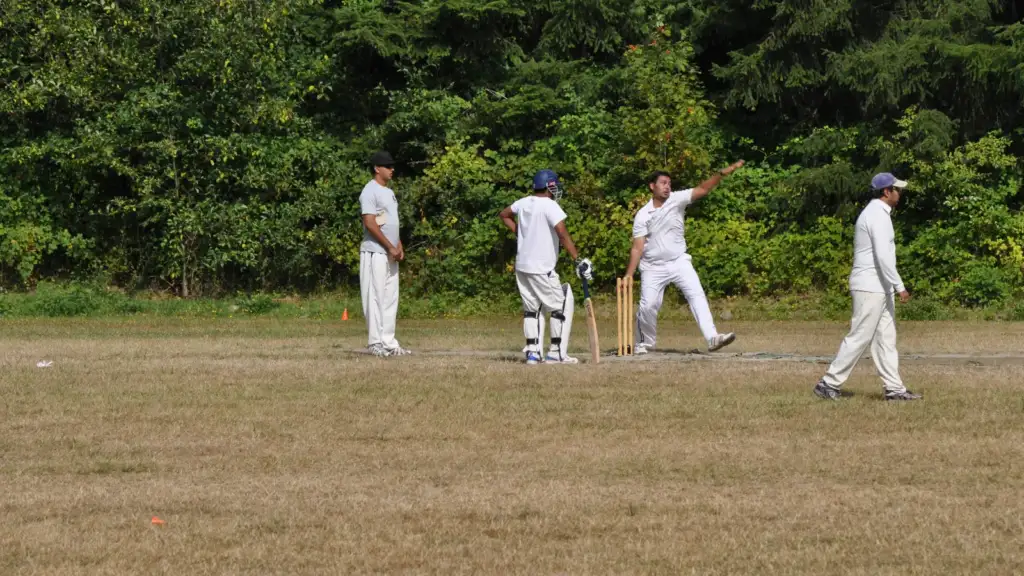
Photo credit: Cricket bowling sequence 09 by Joe Mabel, CC BY-SA 3.0, via Wikimedia Commons.


Join the discussion