

Every autumn the same argument runs: the wrong player won, the votes were political, the statistics said otherwise. Most of that argument happens without anyone checking the rules, which are published and are more specific than the row suggests. Ballon d’Or voting is a ranked ballot cast by a fixed panel of journalists against three stated criteria over a defined season. Knowing how the points are distributed explains most of the results that look strange from the outside.
Updated October 2026. The rules below are the organisers’ published procedure for the current edition; formats have been revised before and may be revised again.
Who actually votes
The men’s jury is 100 journalists, one from each of the 100 countries highest placed in the FIFA Men’s World Ranking. Only one voter per nation is allowed. The women’s award uses the same structure with 50 journalists drawn from the top 50 ranked nations. That design has two consequences worth holding on to. The panel is deliberately international rather than weighted towards the biggest leagues, and the eligible countries change as the FIFA ranking changes, so the electorate is not identical from one year to the next.
The ballot is not open. Jurors choose from a shortlist of 30 nominees drawn up by the France Football editorial team together with L’Equipe, the previous edition’s best-performing juror and UEFA ambassadors. Since 2024 the gala itself has been co-organised by UEFA and Groupe Amaury, with Groupe Amaury keeping ownership of the name and control of the voting system.
The 7 rules of Ballon d’Or voting
- One voter per country. Specialist journalists from the top 100 FIFA-ranked nations for the men’s award, the top 50 for the women’s.
- A closed shortlist of 30. Jurors cannot write in a name that the editorial panel left off the list.
- Each juror ranks ten players. Not one pick, a full ordered list from first to tenth.
- Points fall steeply. 15 for first, then 12, 10, 8, 7, 5, 4, 3, 2 and 1 for tenth.
- Three published criteria. Individual performances and decisive, impressive character; team performances and achievements; class and fair play.
- A season, not a calendar year. The award period runs from August to the following August and includes international tournaments.
- Ties break on first places. Level on points, the player with more first-place votes finishes higher, then second places, and so on.
Why the points scale matters more than the arguments
A 15 to 1 scale across ten slots rewards breadth of agreement. A player named second or third on almost every ballot can beat a player who is first on a large minority of them, because the second and third places keep banking 12 and 10 points while the rivals’ ballots that omit a player bank nothing at all. This is the single most useful thing to know about Ballon d’Or voting: it is closer to a consensus measure than a popularity contest, and it penalises divisiveness heavily.
The published totals make the effect visible. In the 2025 edition Ousmane Dembele finished on 1,380 points, Lamine Yamal on 1,059, Vitinha on 703, Mohamed Salah on 657 and Raphinha on 620. The gap between first and fifth is not a gap in talent so much as a gap in how many of the hundred ballots placed each player near the top. Aitana Bonmati won the women’s award on 506 points ahead of Mariona Caldentey on 478, a far narrower margin on a smaller jury.
The season window, and what it does to the result
Until 2022 the award covered a calendar year. It now covers a football season, which UEFA describes as “the entire season, from August to the following August”, international competitions included. For the 2026 edition the reference period ran from 3 August 2025 to 19 July 2026, and the ceremony is set for 26 October 2026 at the London Palladium, the 70th edition and the first held in London.
That window is why tournament summers dominate. A player whose nation is eliminated early loses several weeks of the assessment period that a finalist gets to fill. It also explains why a strong second half of a domestic season can outweigh a strong first half of the next one: the two sit in different award periods even though they feel like the same run of form.
Why statistics settle less than people expect
None of the three criteria is a number. Class and fair play is a judgement, so is decisive character, and team achievements can be read as trophies won or as how central one player was to winning them. Jurors are not required to publish their reasoning, so two voters can apply the same criteria honestly and rank the same ten players in a different order.
Goals and assists also flatter certain positions. A defender or a holding midfielder accumulates very little of either, which is a large part of why the award so rarely goes to one. The ceremony hands out separate awards partly for this reason, including the Yashin Trophy for goalkeepers, the Kopa Trophy for young players, the Gerd Muller Trophy for scoring and the Johan Cruyff Trophy for coaches. If you want a sense of how differently the game now values defensive positions, our piece on how the attacking full-back evolved covers that shift, and how football transfer fees work explains why the market prices those players the way it does. For another case where a published rulebook settles an argument people keep having, see semi-automated offside.
Common questions
How many people vote for the Ballon d’Or? One hundred journalists for the men’s award, one from each of the 100 highest ranked countries in the FIFA Men’s World Ranking, and 50 for the women’s award from the top 50 ranked countries.
How are the points allocated? Each juror submits an ordered list of ten players from the 30-name shortlist. First place is worth 15 points, then 12, 10, 8, 7, 5, 4, 3, 2 and 1 point for tenth.
What period does the award cover? A football season from August to the following August, including international competitions. The 2026 edition covered 3 August 2025 to 19 July 2026.
What are the official criteria? Individual performances with decisive and impressive character; team performances and achievements; and class and fair play. Jurors weigh them themselves and do not have to explain their ballots.
What happens if two players tie on points? The player with more first-place votes is placed higher. If they are still level, second-place votes are compared, then third places, and so on.
Sources and further reading
Where the figures and rules above come from, so you can check them:
- Jury composition, the points scale, the three criteria and the tie-break: UEFA, how the Ballon d’Or winners are decided
- 2025 final point totals for the men’s and women’s awards: UEFA, 2025 Ballon d’Or voting results
- 2026 reference period, ceremony date and venue, and award categories: Wikipedia, 2026 Ballon d’Or
- Close of voting, jury sizes and the additional trophies: beIN Sports, voting for the Ballon d’Or closes
- Move from calendar year to season, and the UEFA and Groupe Amaury partnership: Wikipedia, Ballon d’Or
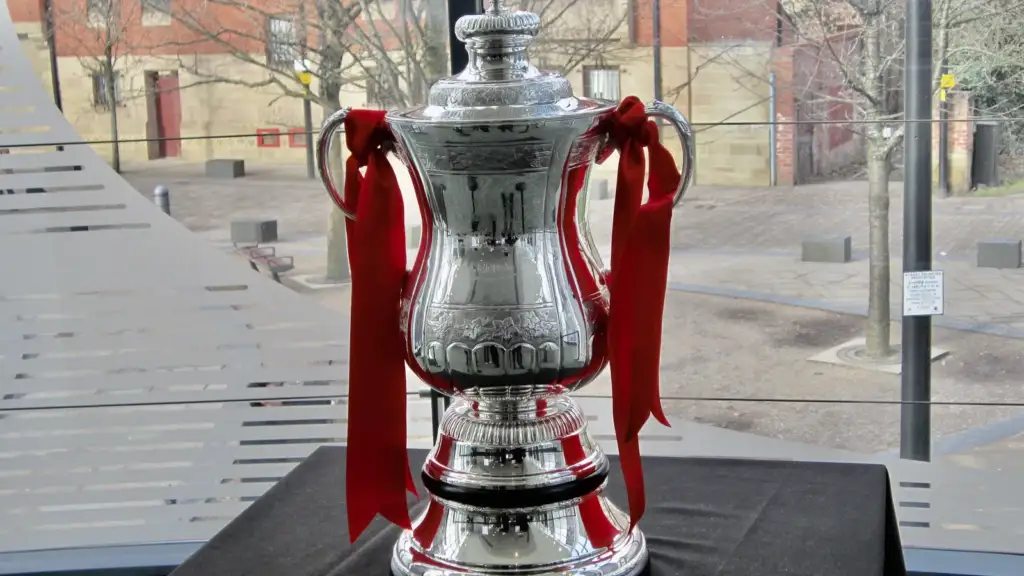
Photo credit: FA Cup Trophy at Manchester National Football Museum (Ank Kumar) 01 by Ank Kumar, CC BY-SA 4.0, via Wikimedia Commons.



Join the discussion