

Visa requirements are published by governments, summarised by everyone else, and relayed most confidently by the people with the least accountability for getting them wrong. Learning to read the primary source is worth more than any summary, including this one. What follows shows where the authoritative text actually lives, what the recurring traps are, and how to recognise the newer entry requirements that are not visas at all but will still stop you at the gate.
Updated October 2026. General information, not legal advice.
Go to the issuing government, and read the page that charges you
The authoritative statement of visa requirements is the government of the country you are travelling to, through its official portal or the embassy or consulate covering where you live. The practical test of whether you are on the right page is whether it is the page that takes your application and your money. Everything else, including travel agents, aggregator sites and news coverage, is a summary of that page at some point in the past.
The level of detail on official pages is usually higher than people expect. The GOV.UK Standard Visitor page, for example, states that the visa costs 135 pounds for up to six months, that the earliest you can apply is three months before you travel, and that you can usually stay for up to six months. It lists what the visa permits, including tourism, visiting family and friends, volunteering for up to 30 days with a registered charity, certain business activities, a permitted paid engagement, a recreational course of up to 30 days, study and medical treatment. It also states what it prohibits: paid or unpaid work for a UK company or as a self-employed person unless you are doing a permitted paid engagement, claiming public funds, living in the UK for long periods through frequent or successive visits, and marrying or registering a civil partnership.
7 costly traps in reading visa requirements
- Reading a summary instead of the portal. Rules change without announcement, and a correct description of last year’s process is still a wrong answer today.
- Measuring passport validity from the wrong date. US Customs and Border Protection states that visitors must hold passports valid for six months beyond their intended period of stay, and publishes a list of countries whose nationals are exempt and need only a passport valid for the intended stay. A passport that covers the trip can still fail.
- Applying in the wrong category. Visitor, business visitor, work, transit and study are separate routes with separate tests. The wrong category is a common cause of refusal, and a refusal is normally recorded and must be declared on later applications, including to other countries.
- Treating the financial test as a number. GOV.UK requires you to show you are able to support yourself and any dependants and to pay for your return or onward journey. It does not publish a figure, which means the evidence has to make the case rather than hit a threshold.
- Getting a document attested or translated by the wrong body. Where a requirement names the authority that must certify a document, certification by anyone else is treated as no certification at all.
- Assuming approval guarantees entry. GOV.UK states plainly that a UK Electronic Travel Authorisation does not guarantee entry. Border officers make the final decision on arrival in almost every country.
- Missing a requirement that is not a visa. Travel authorisations and border registration systems are separate from visas, apply to people who need no visa at all, and are the fastest-growing source of surprises.
The requirements that are not visas
Three current examples are worth knowing because they catch visa-exempt travellers specifically. The United Kingdom’s Electronic Travel Authorisation costs 20 pounds per person, is needed by every traveller including babies and children, and covers travel to the UK, Jersey, Guernsey or the Isle of Man for up to six months. GOV.UK warns that other websites may charge more to apply, which is a reliable signal that you are not on the government page.
The European Union’s Entry/Exit System began operating on 12 October 2025 and was rolled out progressively over six months. The European Commission states that from 10 April 2026 the system is fully operational at all external border crossing points and passport stamping has been replaced by electronic records. It applies to non-EU nationals crossing the external borders for short stays of 90 days in any 180-day period, registering passport data, a facial image and fingerprints at the first entry and the first exit, with a faster verification on each later crossing. The Commission says it systematically detects overstayers, which removes the old margin created by missing or illegible stamps.
The European Travel Information and Authorisation System is the companion requirement for visa-exempt non-EU nationals travelling to 30 European countries. The Commission set the fee at 20 euros, up from the previously planned 7 euros, with people under 18 or over 70 exempt from paying. An authorisation is valid for three years or until the travel document used in the application expires, whichever comes first, and the Commission has said it expects the system to be operational in the last quarter of 2026. Our explainers on ETIAS and EU border checks and the UK ETA track both in more detail.
A reading method that works on any country’s page
- Find the category list first, and read the one above and below yours. The boundaries are where refusals happen.
- Note every date the page mentions, including how early you may apply and how long a decision takes, then work backwards from your travel date.
- Separate what is required from what is recommended. Official pages distinguish the two; summaries usually do not.
- Write down which authority must certify each document, because that is the detail agents most often get wrong.
- Check for a separate travel authorisation even when you need no visa, and check it for every traveller in the party.
Two practical companions: keep a copy of the passport page and the authorisation reference somewhere you can reach without the document itself, which is the first thing covered in what to do about a lost passport abroad, and build the border queue into your timings using how early to get to the airport, since biometric registration takes longer on a first crossing.
Common questions
Where should I check visa requirements? On the official portal of the government you are travelling to, or the embassy or consulate covering where you live. The page that accepts your application and payment is the authoritative one.
Why does my passport need six months of validity? Because many countries require it. US Customs and Border Protection states that visitors must hold passports valid for six months beyond their intended stay, and publishes a list of exempt nationalities who need validity only for the stay itself.
Does an approved visa or travel authorisation guarantee entry? No. GOV.UK states that a UK Electronic Travel Authorisation does not guarantee entry, and border officers make the final decision on arrival in almost every country.
Do I need ETIAS and does it replace a visa? ETIAS is for visa-exempt non-EU nationals travelling to 30 European countries. It is an entry requirement rather than a visa, costs 20 euros with exemptions for under-18s and over-70s, and is valid for three years or until your travel document expires.
What happens if my application is refused? Ask for the reason where the system provides one, fix the underlying issue, and declare the refusal on later applications. Concealing a refusal is normally treated far more seriously than the original refusal.
Sources and further reading
Where the figures and rules above come from, so you can check them:
- Standard Visitor visa: permitted and prohibited activities, fee, length of stay and application window: GOV.UK
- Electronic Travel Authorisation: who needs one, the fee, and that it does not guarantee entry: GOV.UK
- Six-month passport validity rule and the list of exempt countries: US Customs and Border Protection
- Entry/Exit System: start date, six-month rollout, full operation from 10 April 2026 and biometric registration: European Commission press release IP/25/2332
- ETIAS fee, exemptions, 30 countries covered and expected operational date: European Commission, Migration and Home Affairs
- What ETIAS is and the three-year validity rule: Travel to Europe, European Union
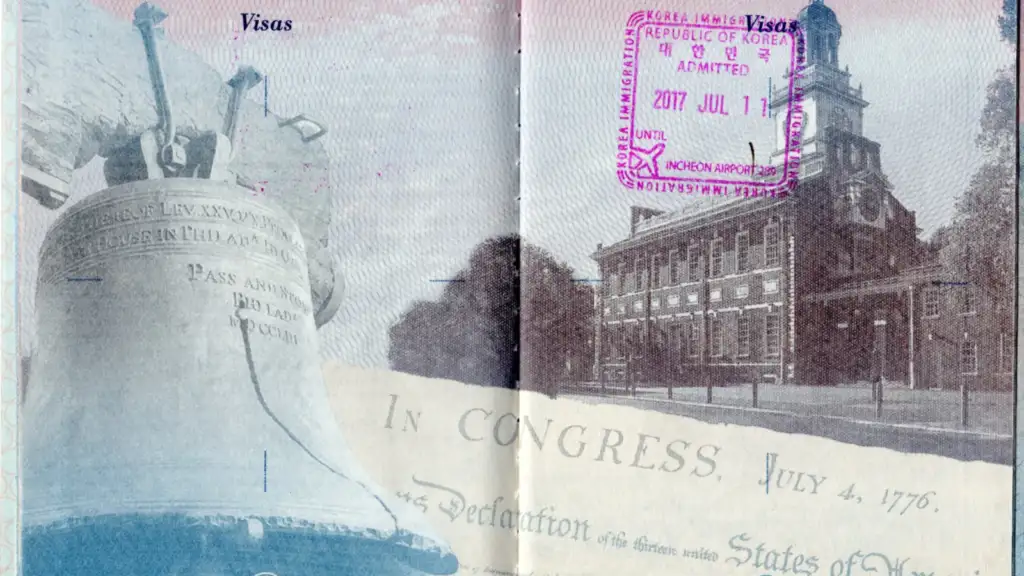
Photo credit: 2017 United States Passport page 8 no stamps and page 9 with stamps South Korea Visas by Ranch9613, CC0, via Wikimedia Commons.


Join the discussion