

Choosing between a laptop RTX 5050 and RTX 5060 looks like a simple tier decision. It is not, because the same card performs very differently depending on the laptop it is fitted to — and that variation can be larger than the gap between the two tiers.
Specifications checked August 2026. Street prices on laptops move constantly and vary by region and retailer, so this compares what the machines are rather than quoting a figure that will be stale within weeks.
The tier difference
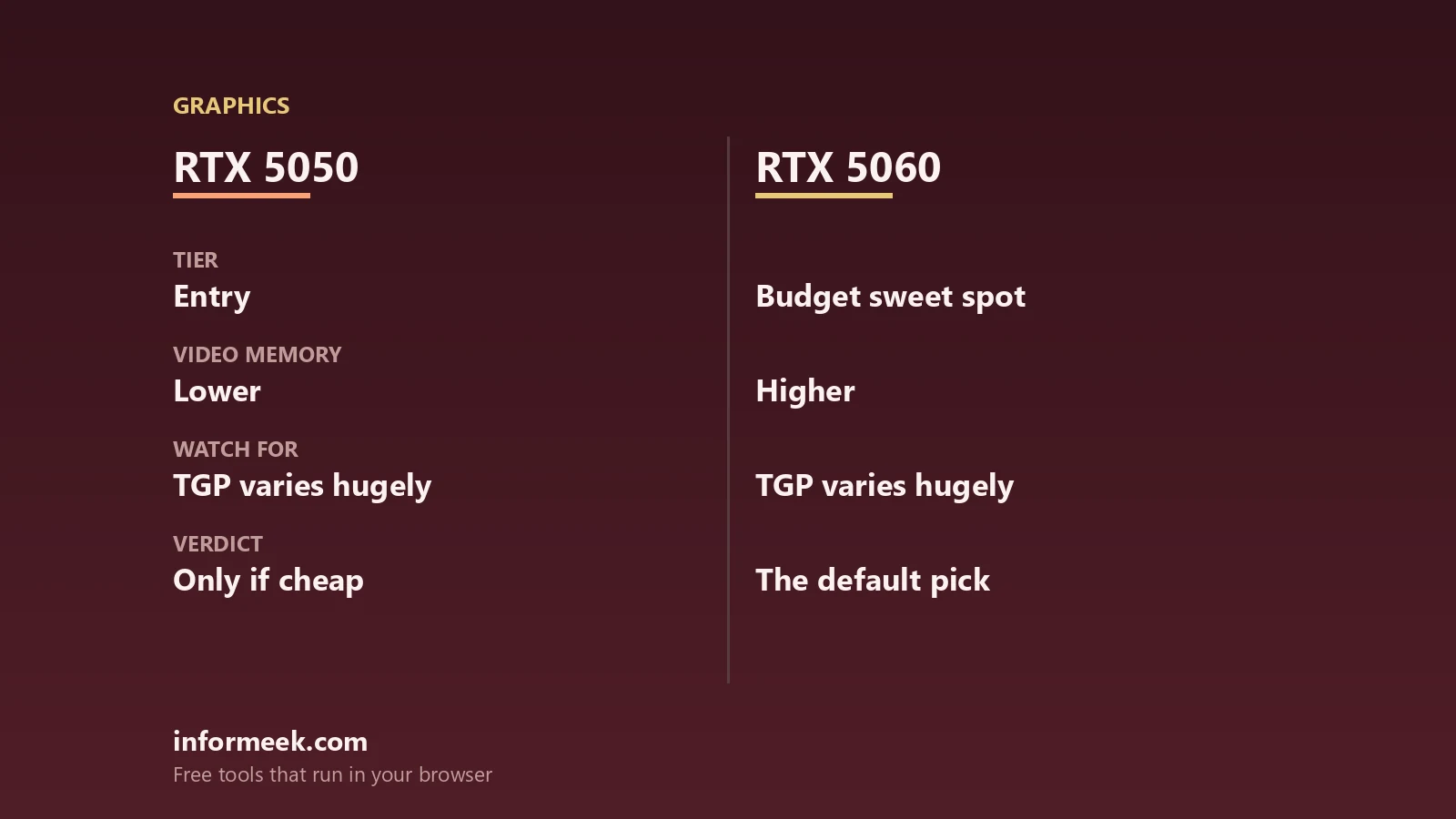
The RTX 5060 sits above the 5050, with more video memory and more capability, and it has become the clear default recommendation for budget gaming laptops this generation. The 5050 is the entry rung: adequate, and worth buying mainly when the price gap is large.
Video memory is the part that ages worst. A card with less of it runs into texture limits in newer games before it runs out of raw speed, and you cannot add more later.
The number that actually predicts performance
Total Graphics Power, usually written TGP, is how many watts the laptop permits the card to draw. It varies enormously between machines carrying the identical chip, and it is the single best predictor of frame rates.
The effect is not subtle. A thin laptop running an RTX 5070 at 80W will trail a thicker one running the same RTX 5070 at 115W in real games. The same applies down the range — a well-cooled 5050 can close much of the gap to a starved 5060.
- Thin and light means lower TGP. Physics, not cost-cutting. There is nowhere for the heat to go.
- Manufacturers rarely advertise it. When a spec sheet states a wattage, as the Acer Nitro V 16S AI does at 85W, treat that as a point in its favour.
- Reviews measure it. Sustained frame rates in a review tell you more than any specification list.
How to buy sensibly
Decide the tier first — RTX 5060 unless the 5050 is meaningfully cheaper — then choose between machines on cooling rather than on the card. Look for a review of your exact configuration, check sustained performance rather than peak, and prefer the thicker chassis when the price is equal.
If two laptops have the same card and the same price and one is noticeably slimmer, the slimmer one is almost certainly slower under load.
Common questions
Is a laptop RTX 5060 the same as the desktop card? No. Laptop parts share a name and run at far lower power. Never assume desktop benchmarks transfer.
How do I find the TGP? Manufacturer spec pages sometimes state it; otherwise reviews measure it. If neither source has it, that absence is itself informative.
Does more video memory help at 1080p? Increasingly yes, as textures grow. It is the specification most likely to limit a card in a few years.
Should I wait for the next generation? There is always a next generation. Buy when you need the machine, and buy the best-cooled version you can afford.
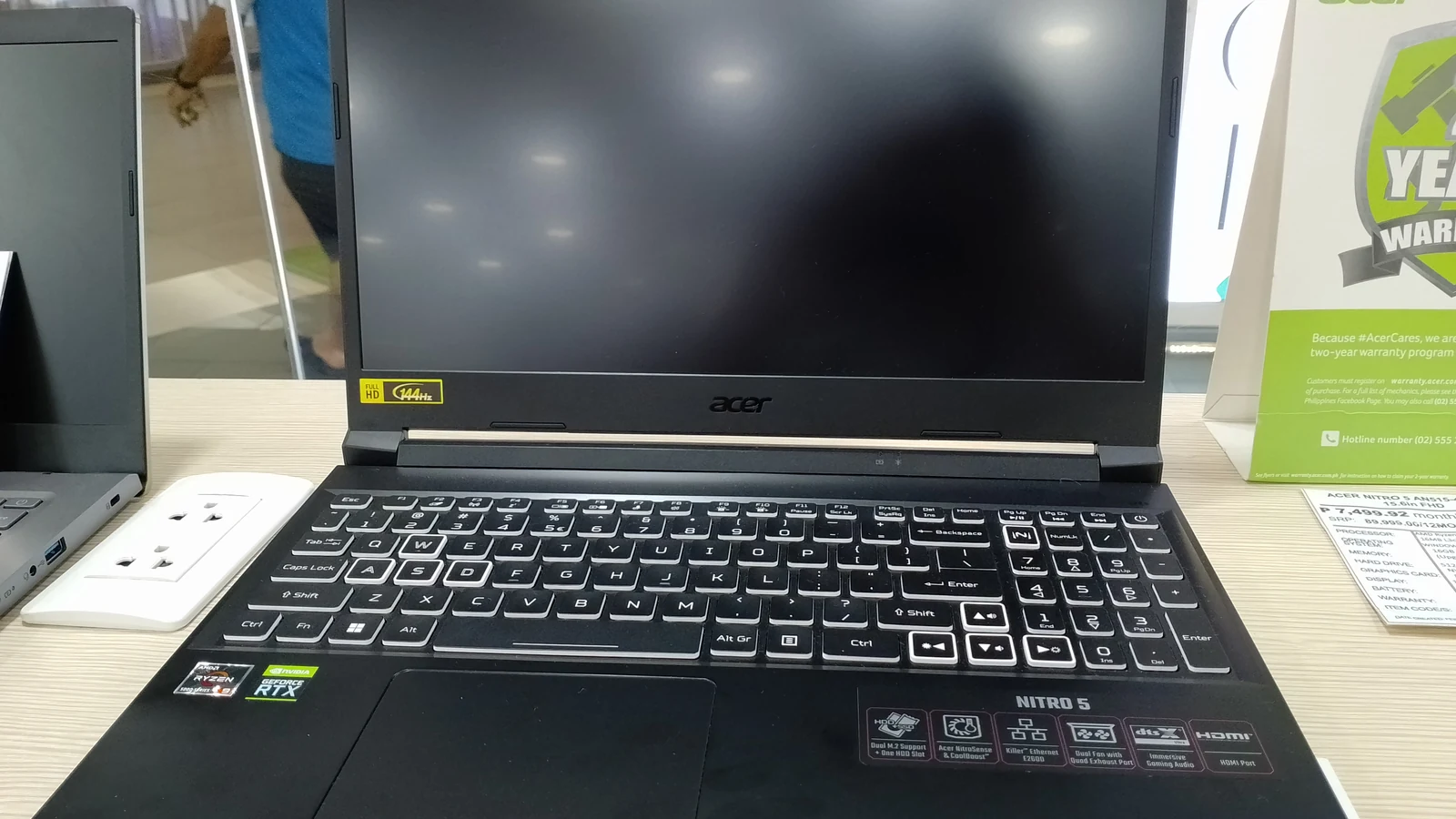
Cover photograph: Acer Nitro 5, by PaulGorduiz106, licensed CC BY-SA 4.0 via Wikimedia Commons. The photograph shows an earlier model from the same range rather than the machines compared above.



Join the discussion