

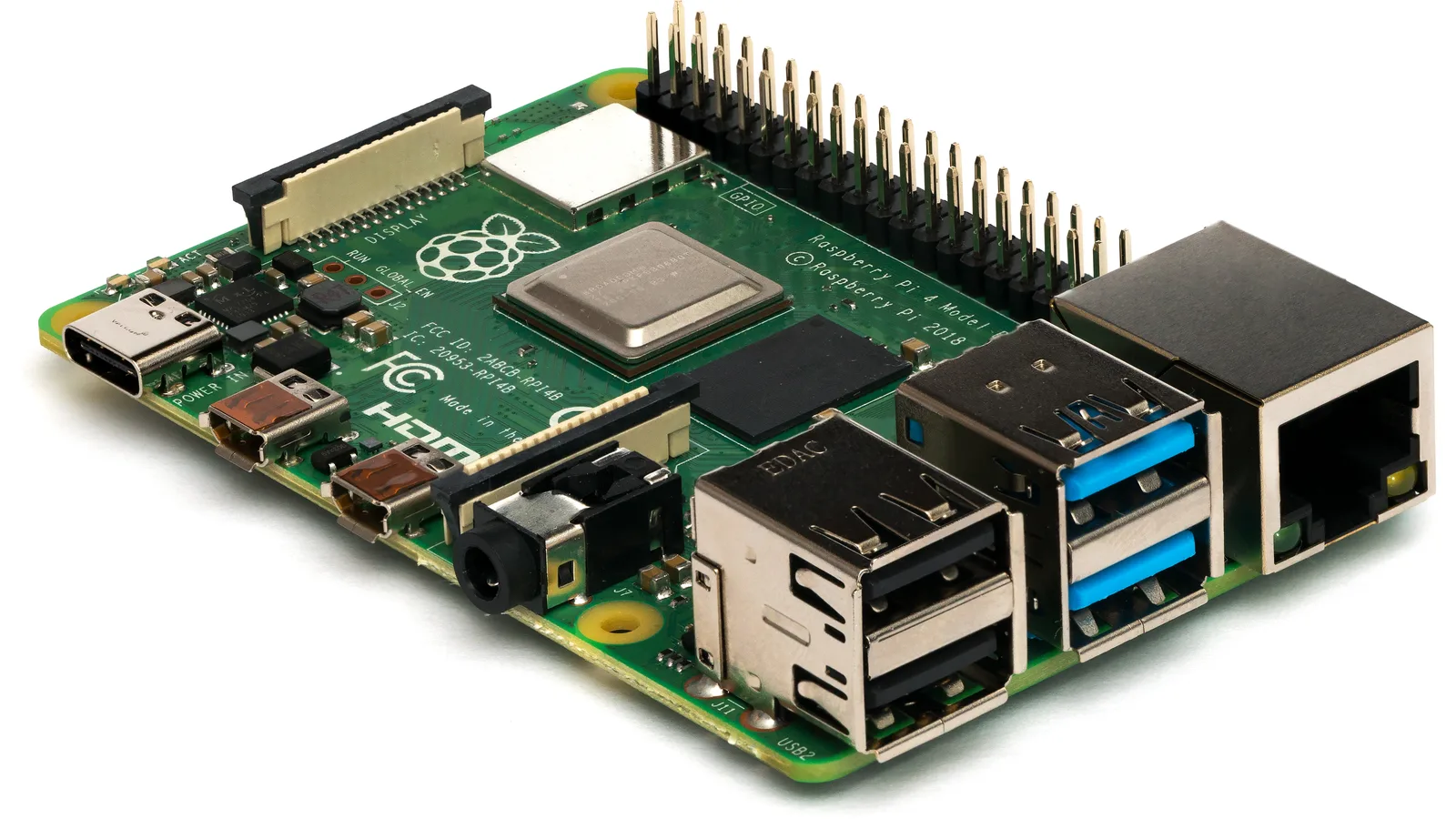
A small language model is the same kind of system as the assistants everyone knows, built at a size that fits on a laptop, a phone or a modest server. The interesting part of 2026 is not that these exist, it is that they have become good enough for a large share of ordinary work, which changes where the model should sit and who pays for each request.
Updated September 2026.

What counts as a small language model
There is no official cut-off. IBM’s explainer describes these models simply as smaller in scale and scope than large language models, with parameter counts ranging from a few million to a few billion, against the hundreds of billions or trillions claimed for the largest systems. In practice the useful test is whether the model runs on hardware you already own.
Published model cards make the range concrete. Microsoft’s Phi-4-mini-instruct, released in February 2025, has 3.8 billion parameters and a 128,000 token context window, and its card names memory and compute constrained environments and latency bound scenarios among its intended uses. Meta’s Llama 3.2 text models are 1.23 billion and 3.21 billion parameters, and the card states that they “are expected to be deployed in highly constrained environments, such as mobile devices”. Google’s Gemma 3 family covers 1B, 4B, 12B and 27B, with a 128,000 token window above 1B, and its card says the relatively small size makes deployment possible on laptops, desktops or your own cloud infrastructure.
How the small ones are made
Three techniques do most of the work, and IBM groups them together as compression. Pruning removes parameters and connections that contribute little. Quantisation stores each remaining weight with fewer bits, for example moving from 32 bit floating point to 8 bit integers. Knowledge distillation trains a smaller student model to reproduce the behaviour of a larger teacher. Low rank factorisation, which approximates large weight matrices with smaller ones, is a fourth.
The effect is measurable on published artefacts rather than in theory. Meta’s Llama 3.2 card lists a quantised 1B build at 1,083 MB against 2,358 MB for the BF16 original, with the trade recorded honestly in the same table: the quantised variants ship an 8,000 token context rather than 128,000.
Those file sizes are the reason the category exists. The Gemma 3 downloads listed in Ollama’s library run from 292 MB for the 270M build and 815 MB for 1B up to 3.3 GB for 4B, 8.1 GB for 12B and 17 GB for 27B. The first three of those fit comfortably in the memory of an ordinary laptop or a cheap server instance, and the last two do not fit on most phones at all. Where a model can physically sit decides the architecture around it: on-device, on a machine inside your own network, or on somebody else’s GPU with a bill attached. That is a design decision as much as a technical one, and it is easier to make once you have looked at the actual numbers rather than the marketing tier.
5 good reasons to use a small language model
- The data never leaves. If the model runs on the device or inside your own network, sensitive text is not sent to a third party at all, which removes a whole class of policy argument.
- Cost is predictable. Hardware you own does not bill per token. For high volume repetitive work, that changes the arithmetic completely.
- Latency is lower and steadier. No network round trip, no queue behind other customers. Model cards such as Phi-4-mini name latency bound scenarios explicitly as a target.
- Narrow tasks do not need a general model. A 2025 paper, “Small Language Models are the Future of Agentic AI”, argues that for agent systems that call a model repeatedly for specialised subtasks, smaller models are sufficiently capable, better suited and more economical, with larger models reserved for the parts that need open conversation.
- You keep control of versions. An open weights model you host does not change under you, get deprecated on a vendor timetable, or quietly alter its behaviour between releases.
What you give up
IBM is direct about the cost: smaller systems can show decreased performance on complex tasks and more limited generalisation, because less capacity means less stored knowledge. In everyday terms, expect weaker results on long multi-step reasoning, on obscure factual recall, and on tasks that require holding a large amount of material in mind at once. Quantised builds often ship with shorter context windows than the full precision original, which matters if you feed in long documents.
There is also work that a hosted service was doing for you: capacity planning, updates, monitoring and evaluation. Whether that is a fair trade depends on whether you already have the MLOps practice to absorb it.
How to choose one
- Write the task down first, with ten or twenty real examples and the answers you would accept. Without that, you cannot tell whether a smaller model is adequate.
- Check the licence, not just the benchmark table. Open weights does not automatically mean unrestricted commercial use.
- Read the card for context length and languages, and note whether the figure applies to the quantised build you will actually run.
- Test at the quantisation you will deploy, because a full precision result tells you little about a 4 bit one.
- Plan the fallback. Routing the hard cases to a larger model is a normal design, not an admission of defeat.
Small models are also why agentic AI is becoming affordable to run at volume, since an AI agent may call a model dozens of times to finish one task.
Common questions
What is a small language model? It is a language model built at a size that runs on ordinary hardware, typically from a few million to a few billion parameters, rather than the hundreds of billions used by the largest hosted systems.
How many parameters is small? There is no fixed line. Published examples include Llama 3.2 at 1.23 billion and 3.21 billion, Phi-4-mini at 3.8 billion, and Gemma 3 at 1B, 4B, 12B and 27B. The practical test is whether it fits your hardware.
Are smaller models less accurate? On complex reasoning and obscure knowledge, generally yes. On narrow, well-defined tasks with good instructions and retrieved context, the gap is often small enough not to matter.
Can one run on a phone? Meta states that the Llama 3.2 1B and 3B models are expected to be deployed in highly constrained environments such as mobile devices, and ships quantised builds sized for that.
When should I still use a large model? For open-ended reasoning, long documents, unusual domains and anything where a wrong answer is expensive. Many teams route most traffic to a small model and escalate the rest.
Sources and further reading
Where the figures and rules above come from, so you can check them:
- Definition, parameter ranges, compression techniques and trade-offs: IBM
- Parameter count, context window and intended uses: Microsoft Phi-4-mini-instruct model card
- Parameter counts, mobile deployment and quantised build sizes: Meta Llama 3.2 model card
- Family sizes, context window and deployment on laptops and desktops: Google Gemma 3 model card
- Gemma 3 download sizes by parameter count: Ollama model library
- Small Language Models are the Future of Agentic AI (2025): arXiv
- What quantisation is and why it reduces memory: Hugging Face Optimum documentation
Photo credits: Raspberry Pi 4 Model B – Side by Laserlicht, CC BY-SA 4.0, via Wikimedia Commons. P20231120AS-1277 by The White House, Public domain, via Wikimedia Commons.
At the other end of the scale sits the frontier model. Here is what is known about GPT-6.


Join the discussion