

Smart glasses provoke a question that neither the wearer nor the people around them can usually answer: what is actually being captured, and can you tell? The honest answer is less alarming than the anxiety and less obvious than the design implies. Manufacturers publish more about this than people realise. What follows works from the makers’ own statements and from the regulators who have examined them.
Updated October 2026. General information, not legal advice.
6 simple facts about what smart glasses record
- They are not filming continuously. Capture is triggered, by a button or a voice command, and the battery makes the alternative impractical. Meta gives its Ray-Ban Display up to six hours of mixed-use battery life, extending to up to 30 hours in total with the charging case, in a frame weighing 69 grams.
- The capture light has no off switch. Meta states that every pair of its AI glasses has a light on the front it calls a capture LED, that this white light blinks whenever content is being captured for your gallery, and that the capture LED has no off switch.
- Covering the light disables the camera. Meta says that if the glasses detect the capture LED has been covered, physically tampered with or destroyed, they automatically disable the camera.
- Clips start on the glasses, not in the cloud. Meta states that photos and videos captured for your gallery are stored privately on the glasses and that you choose when to import them to your phone, where the Meta AI app is used to review, edit and share.
- Asking the glasses about what you are looking at is a different data flow. A clip recorded locally and an image sent to a server for an AI feature to analyse are not the same thing, and the settings that govern them are separate.
- Audio changes the legal analysis, images usually do not. Photography in a public place is broadly lawful across the UK, the United States and much of Europe. Recording a conversation is a different question, covered below.
The indicator light is the entire social contract
The light exists because regulators pressed for it. On 17 September 2021 the Irish Data Protection Commission, acting with the Italian Garante, noted that there is a very small indicator light that comes on when recording is occurring, said it had not been demonstrated that comprehensive field testing had been carried out to verify the light’s effectiveness in notifying people they are being recorded, and called on Facebook Ireland to confirm and demonstrate that the light was effective for its purpose and to run an information campaign alerting the public to how the product could create less obvious recording of their images.
Five years on, the design has improved and the underlying weakness has not. Tamper detection that disables the camera when the light is covered is a genuine advance over a light that could simply be taped over. The light is still small, still easy to miss in bright sunlight, still invisible from behind or in profile, and still meaningless to anyone who does not know what it signifies. It warns the people who already know to look for it, a smaller group than the number of people in shot.
Where the recordings go, and the setting worth finding
The sequence is consistent across current products. Capture happens on the glasses, which hold clips in internal memory. The clips then sync to a phone application, and from there they may reach the manufacturer’s cloud service depending on your settings. Meta’s camera documentation describes a 12 MP ultra-wide camera and says the glasses sync with the Meta AI app where media can be reviewed, edited and shared.
The setting worth hunting for is whether captured media and voice interactions are used to improve the company’s products, which is normally a separate toggle from cloud backup. Treat the two as independent decisions. If the glasses answer questions about what you are looking at, assume images leave the device for that to work.
What the law actually says
Under the GDPR, Article 2(2)(c) excludes processing “by a natural person in the course of a purely personal or household activity”, which is why private recreational footage is generally outside the regime. The boundary is tighter than wearers assume. The Information Commissioner’s Office position on home cameras is that data protection law applies once recording extends beyond your own property boundary to a public area, a communal space or someone else’s property, and that a clear connection to a professional or commercial activity brings it in too. The ICO also advises that surveillance systems should not normally be used to record conversations between members of the public, calling that highly intrusive and unlikely to be justified.
In the United States the federal baseline is one-party consent. Section 2511(1)(a) of title 18 prohibits intentionally intercepting any wire, oral or electronic communication, and section 2511(2)(d) exempts a person not acting under colour of law who is a party to the communication, or where one party has given prior consent, unless the interception is for the purpose of committing a criminal or tortious act. Several states go further. California Penal Code section 632 requires the consent of all parties before using an electronic amplifying or recording device to eavesdrop on or record a confidential communication, meaning one carried on in circumstances reasonably indicating that a party wants it confined to the parties, and provides for fines of up to 2,500 dollars for a first offence and up to 10,000 dollars for a later one. Private property is a separate matter again: shops, gyms, hospitals, schools, courts and workplaces can and do prohibit recording whatever the general law says.
Practical etiquette, for both sides
- If you wear them, say so. One sentence when you sit down with people removes the whole problem, and it is the only step that does not depend on someone spotting a small light.
- Take them off where a phone camera would be unwelcome. Changing rooms and toilets are protected everywhere, and the useful test elsewhere is not whether you are permitted but whether people would object if they knew.
- Turn off product improvement sharing unless you want it. It is usually a separate setting from backup.
- Check the workplace policy before wearing them to work.
- If you are around them, look for the light and ask. Asking is reasonable and most wearers answer plainly.
The same questions recur across every always-present microphone and camera, which is why our pieces on what smart speakers hear, how reverse face search works and drone rules for beginners reach the same conclusion: the technology is more limited than the fear and less visible than the design suggests, and the only reliable safeguard is a norm of saying so.
Common questions
Do smart glasses record all the time? No. Capture is triggered by a button or voice command and the clips are short. Meta gives its Ray-Ban Display up to six hours of mixed-use battery life, which rules out all-day video.
Can the recording light be turned off? Meta states that the capture LED has no off switch, and that the camera is automatically disabled if the glasses detect the light has been covered, physically tampered with or destroyed.
Where are the photos and videos stored? Meta says photos and videos captured for your gallery are stored privately on the glasses and that you choose when to import them to your phone, where they are managed in the Meta AI app.
Is it legal to film people in public with smart glasses? Photography in public is broadly lawful in the UK, the United States and much of Europe. Audio is the exception: the US federal rule allows one-party consent, while California Penal Code 632 requires all parties to consent to recording a confidential communication.
Does the GDPR apply to my own footage? Article 2(2)(c) excludes purely personal or household activity. The ICO treats recording beyond your property boundary, or anything with a commercial purpose, as covered by data protection law.
Sources and further reading
Where the figures and rules above come from, so you can check them:
- Capture LED with no off switch, tamper detection and on-glasses storage: Meta, AI glasses questions answered
- Capture LED behaviour and camera disabling when the light is blocked: Meta, privacy settings for AI glasses
- Battery life, weight, display light leakage and the capture LED: Meta Ray-Ban Display announcement
- Camera resolution, internal storage on the glasses and syncing to the app: Meta, camera glasses
- Statement on the indicator light and the request for field testing and an information campaign: Data Protection Commission of Ireland, 17 September 2021
- Article 2(2)(c), purely personal or household activity: GDPR text
- When camera recording is covered by data protection law, and advice on recording conversations: Information Commissioner’s Office
- Interception prohibition and the one-party consent exception: 18 U.S.C. 2511, Cornell Legal Information Institute
- All-party consent for confidential communications and the penalties: California Penal Code section 632
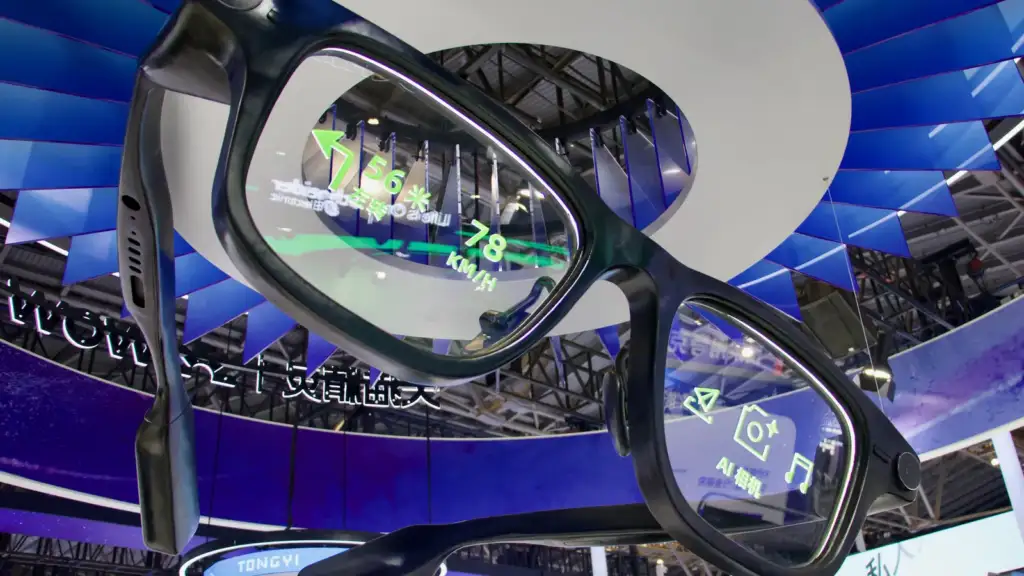
Photo credit: WAIC 2025 – Alibaba Quark Glasses 03 by Xuthoria, CC BY-SA 4.0, via Wikimedia Commons.



Join the discussion