

Small camera drones have become easy enough to fly that a great many owners do not realise they are operating aircraft under aviation law. The drone rules that apply to you depend on where you are, what the aircraft weighs, whether it carries a camera and what class mark it has, and the thresholds are lower than most people assume. This guide uses the published requirements from the UK Civil Aviation Authority, the US Federal Aviation Administration and the European Union Aviation Safety Agency, which agree on the principles while differing on the numbers.
Updated October 2026. General information, not legal advice.
Registration: two separate things, and low thresholds
In the United Kingdom there are two registrations. A Flyer ID shows you have passed the CAA’s official theory test, and an Operator ID must be labelled on the aircraft. The CAA requires a Flyer ID for any drone or model aircraft weighing 100g or above. It requires an Operator ID if the aircraft weighs 250g or above, or weighs 100g or above and has a camera. Below 100g neither is required, though the CAA recommends taking the test anyway. You must be 18 or over to hold an Operator ID, so an owner under 18 has to ask a parent or guardian to register while flying on their own Flyer ID. A household may therefore need one Operator ID and a separate Flyer ID for each person who flies.
In the United States, the FAA requires registration if the drone weighs 250 grams or more. Registration costs 5 dollars and is valid for three years; under the Exception for Limited Recreational Operations that one registration covers every drone in your inventory, while Part 107 registration is 5 dollars per drone. You must be 13 or older to register, the registration number must be marked on the aircraft, you must carry the certificate when you fly, and you must show it to law enforcement if asked. The FAA also requires recreational flyers to pass the free online Recreational UAS Safety Test and carry proof, and says drones that are required to be registered must comply with Remote ID.
One FAA point is routinely missed: compensation is not what decides whether a flight is recreational. The agency says the default regulation for drones under 55 pounds is Part 107, and that when in doubt you should assume Part 107 applies.
8 essential drone rules and limits
- 120 metres, or 400 feet. The CAA sets 120m (400ft) above the surface in every open sub-category, EASA sets 120m above ground level, and the FAA sets 400 feet in uncontrolled Class G airspace.
- Direct visual line of sight. The CAA requires you to keep the aircraft in direct sight at all times with a full view of the surrounding airspace. The FAA allows a visual observer who is co-located with you and in direct communication. Watching the camera feed is not line of sight.
- Separation from uninvolved people, which depends on your category. In the UK’s Far from People (A3) sub-category you must not fly within 50m horizontally of people who are not involved, or over them. In Near People (A2) with a UK2 or C2 class drone the figure is 30m, reducible to 5m in low-speed mode. In Over People (A1) with a drone under 250g you may fly closer than 50m and over uninvolved people.
- Distance from places, not just people. A3 also requires you to stay at least 150m horizontally from residential, recreational, commercial and industrial areas, and at least 50m from an individual building, where individual means at least 50m from other buildings. EASA sets 150m from uninvolved people and urban areas in its own A3.
- Never over crowds. The CAA prohibits flying over crowds even in A1. EASA states that no flights over assemblies of people are permitted in the open category.
- Flight restriction zones around aerodromes. These combine an aerodrome traffic zone, a cylinder with a radius of 2 nautical miles where the longest runway is 1,850 metres or shorter and 2.5 nautical miles where it is longer, extending from the surface to 2,000 feet above ground level, with runway protection zones 1km wide running 5km out from each runway end. Flying there needs permission. In the United States, controlled airspace needs prior FAA authorisation through LAANC or DroneZone.
- Permission to take off and land. Aviation authorities regulate the airspace, not the ground beneath it. The CAA tells you to make sure the person or organisation that owns the land allows take-off and landing from their property, which is why a flight can be lawful in airspace terms and still a byelaw offence or a trespass.
- Light and visibility conditions. If you fly at night in the UK your aircraft must have a green flashing light turned on. Class marks and class-specific conditions also apply: new models placed on the UK market from 1 January 2026 must carry a UK class mark from UK0 to UK6, and a C class drone may be flown as the equivalent UK class until 31 December 2027.
Automatic modes do not transfer responsibility
Subject-tracking and follow-me features are the selling point of this category of aircraft, and they create a specific misunderstanding. You remain the remote pilot. Nothing in the published drone rules shifts responsibility for separation, airspace or the behaviour of the aircraft to the software. The FAA tells recreational flyers that drones are aircraft, that other aircraft can and do fly low, and that the reason to keep yours within visual line of sight is so you can see them and avoid them. A drone that has followed you around a corner is outside your line of sight, however capable its tracking is.
Where data protection law starts to apply
A camera drone becomes a data-processing question the moment it records identifiable people. Article 2(2)(c) of the GDPR excludes processing “by a natural person in the course of a purely personal or household activity”, which is why purely private recreational footage is generally outside the regime. The exclusion is narrower than it sounds. The Information Commissioner’s Office takes the view that a camera recording beyond your own property boundary, capturing a public area, a communal space or a neighbour’s property, brings data protection law into play, and that a clear connection to a professional or commercial activity does the same. The same reasoning applies to other wearable and roadside cameras, as our pieces on what smart glasses record and how number plate recognition works discuss, and how drone delivery works covers what happens when the flight is commercial from the outset.
Common questions
Do drone rules apply to a small toy drone? Often yes. The CAA requires a Flyer ID from 100g and an Operator ID from 250g, or from 100g if the aircraft has a camera. The FAA requires registration from 250 grams. Check your model’s take-off mass rather than assuming small means exempt.
How high can I legally fly? 120 metres or 400 feet above the surface under the UK Drone Code and EASA open category rules, and 400 feet in Class G airspace under the FAA’s recreational rules.
Do I need permission to fly near an airport? Yes. UK flight restriction zones combine an aerodrome traffic zone of 2 or 2.5 nautical miles radius up to 2,000 feet with runway protection zones 1km wide extending 5km from each runway end. In the United States, controlled airspace requires prior FAA authorisation through LAANC or DroneZone.
Can I take off from a park or a beach? Only if the landowner allows it. The CAA says you must make sure the person or organisation that owns the land permits take-off and landing, and that is separate from whether the airspace is legal.
Is filming other people allowed? Purely personal and household recording is generally outside the GDPR under Article 2(2)(c), but the ICO treats recording beyond your own property boundary, or anything with a professional or commercial purpose, as covered by data protection law.
Sources and further reading
Where the figures and rules above come from, so you can check them:
- Flyer ID and Operator ID thresholds, age rules, class marks and sub-category distances: UK Civil Aviation Authority Drone and Model Aircraft Code
- A1 and A3 height, line of sight, distance and night lighting rules: UK Civil Aviation Authority
- Flight restriction zones, aerodrome traffic zones and runway protection zones: UK Civil Aviation Authority
- Recreational rules, TRUST, 400 feet in Class G, LAANC and when Part 107 applies: US Federal Aviation Administration
- Registration threshold, fees, validity, age requirement and Remote ID: US Federal Aviation Administration
- Open category A1, A2 and A3 weight limits, distances and training requirements: European Union Aviation Safety Agency
- Article 2(2)(c), purely personal or household activity: GDPR text
- When domestic camera recording is covered by data protection law: Information Commissioner’s Office
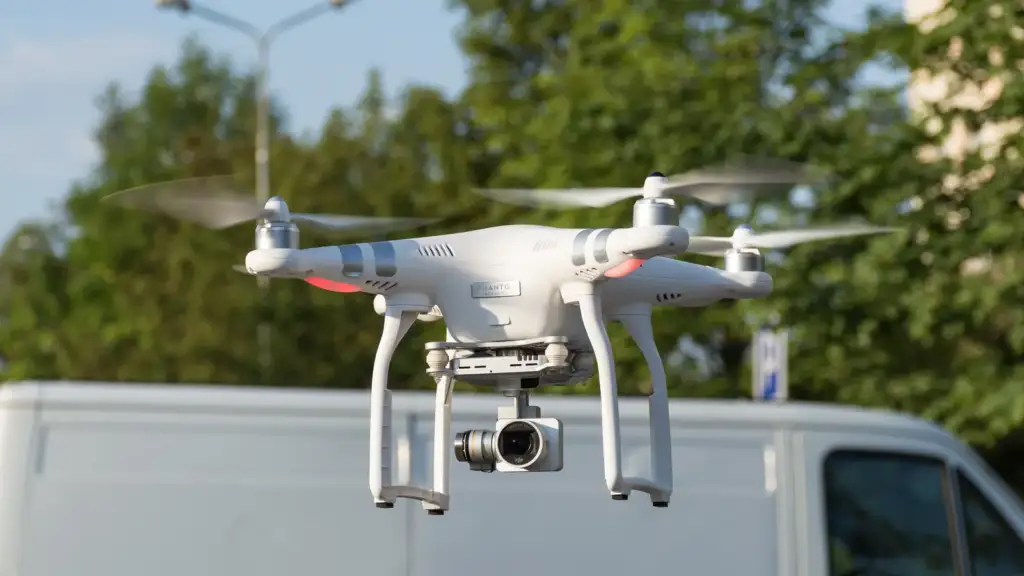
Photo credit: 2015 Dron DJI Phantom 3 Advanced by Jacek Halicki, CC BY-SA 4.0, via Wikimedia Commons.



Join the discussion