

In-flight wifi has a poor reputation, and the reasons are mostly published. An aircraft is a metal tube travelling at around 900 km/h with a single antenna on top of it, and whatever capacity that antenna receives is divided among everyone on board. Once you know what the antennas are rated at, the experience stops being mysterious. This article covers the two ways a signal reaches an aircraft, the figures manufacturers publish per aircraft rather than per passenger, what aviation and communications rules actually require, and the limits no provider can design away.
Updated October 2026.
Two ways to get in-flight wifi to a moving aircraft
The first is air to ground. Dedicated masts on the surface point upwards and the aircraft carries what is effectively a mobile terminal. Gogo describes its next generation air to ground network as delivering speeds of up to 80 Mbps, built end to end on 5G with 5G chipsets in the airborne equipment, 5G radios at each base station and 5G core services in the data centre. The limitation is geographic: towers only exist over land that someone has chosen to cover, so the approach works across a continent and not across an ocean.
The second is satellite, and it now splits again. Geostationary systems use Ku or Ka band spacecraft parked above the equator. Viasat’s in-flight connectivity documentation describes a medium profile full duplex Ka band airborne antenna with a swept diameter of 37.30 inches, or 94.74 cm, a height of 8.60 inches and a weight of 75 lbs, around 34 kg, feeding cabin access points that support the latest 802.11 standards, with an in-flight entertainment server drawing a maximum of 200 watts. Low Earth orbit systems are the newer option. Gogo Galileo uses Eutelsat’s OneWeb network and publishes HDX at 60 Mbps down and 11 Mbps up and FDX at 195 Mbps down and 32 Mbps up, from antenna assemblies weighing 9.80 kg and 18.14 to 20.41 kg respectively, with maximum power draws of 165W and 330W.
The number that explains everything: one pipe per cabin
Those speeds are per aircraft. That is the single most useful fact about in-flight wifi, and it is the one marketing copy tends to leave implicit. Sixty megabits per second is a decent home connection and a thin one when it is the entire supply for a cabin. The hardware figures make the constraint tangible: a single fuselage mounted antenna, one modem, a fixed power budget, and a cabin full of devices behind it.
Capacity is therefore the metric that matters, and providers say so. Viasat frames capacity as how many bits of data can pass through the satellite at one time, and argues that the more capacity there is in the network, the more bandwidth each user gets and the better the experience. That is why the industry keeps launching higher throughput spacecraft rather than simply selling faster plans: the bottleneck is upstream of the seat.
5 hard limits
- The pipe is shared. Published figures such as 60 Mbps down are for the whole aircraft, so your share falls as the cabin fills.
- Coverage follows infrastructure. Air to ground works where masts exist, over land. Oceans and remote regions need satellite, and that changes the hardware and the cost.
- The antenna is a physical object with a power budget. Assemblies weigh tens of kilograms and draw up to 330W, which is why the fastest terminal is not simply fitted to every airframe.
- Airlines shape the traffic. Access points and servers are airline equipment, and what is prioritised or blocked is a commercial decision made before you connect.
- Regulation sets the floor. What you may switch on is determined by rules and by your airline, not by the capability of your phone.
What the rules actually say
Two separate authorities are involved in the United States, and they do different jobs. Communications rules prohibit airborne cellular use outright: the regulation states that cellular telephones installed in or carried aboard airplanes, balloons or any other type of aircraft must not be operated while such aircraft are airborne, and requires a placard near any installed phone warning that use while airborne is prohibited by FCC rules and that violation could result in suspension of service or a fine.
Aviation rules are structured differently. The portable electronic devices rule prohibits operating such a device on the aircraft it covers, then exempts devices the operator has determined will not cause interference with the navigation or communication systems of the aircraft. For air carrier operations that determination is made by the operator. In plain terms, your airline decides what you may use, which is why the cabin announcement varies between carriers on identical aircraft types. If you are packing for a trip, our travel tech checklist covers what is worth bringing, and our guide to what a VPN protects is relevant on any shared network you did not configure.
Getting the most out of it
Download what you intend to watch before you board, because streaming is the single heaviest thing you can ask of a shared link. Connect early, before the cabin does. Expect messaging, email and web pages to work and video calls to be unreliable, whatever the provider’s figures suggest is possible. And treat the published speed as the ceiling for the whole aircraft rather than a promise to you. The same physics applies on the ground when a satellite link replaces a cable, which we cover in how satellite internet works.
Common questions
Why is in-flight wifi so slow? Because the published speed is per aircraft, not per passenger. A system rated at 60 Mbps down supplies the whole cabin through one antenna and one modem, so each additional device reduces everyone share.
What is the difference between air to ground and satellite systems? Air to ground uses masts on the surface and only works over covered land. Gogo describes its 5G air to ground network as delivering up to 80 Mbps. Satellite works over oceans and remote areas but needs a larger, heavier antenna.
Are low orbit systems faster on aircraft? The published figures are higher. Gogo Galileo on the OneWeb low orbit network lists 60 Mbps down and 11 Mbps up for its smaller HDX antenna and 195 Mbps down and 32 Mbps up for the larger FDX.
Why can I not make a phone call? Communications rules prohibit operating cellular telephones carried aboard an aircraft while it is airborne, and require a warning placard near any installed phone. Wifi calling is a separate matter decided by the airline.
Who decides whether I can use a device in flight? The aircraft operator. The aviation rule prohibits portable electronic devices except those the operator has determined will not interfere with navigation or communication systems, which is why policies differ between airlines.
Sources and further reading
Where the figures and rules above come from, so you can check them:
- Gogo Galileo HDX and FDX published speeds, antenna weights and power, and the OneWeb network: Gogo Galileo datasheet
- Air to ground speeds of up to 80 Mbps and the end to end 5G design: Gogo 5G overview brochure
- Ka band antenna dimensions and weight, cabin access points and server power: Viasat in-flight connectivity solutions
- Prohibition on airborne operation of cellular telephones, 47 CFR 22.925: Legal Information Institute, Cornell Law School
- Portable electronic devices and who determines permitted use, 14 CFR 91.21: Legal Information Institute, Cornell Law School
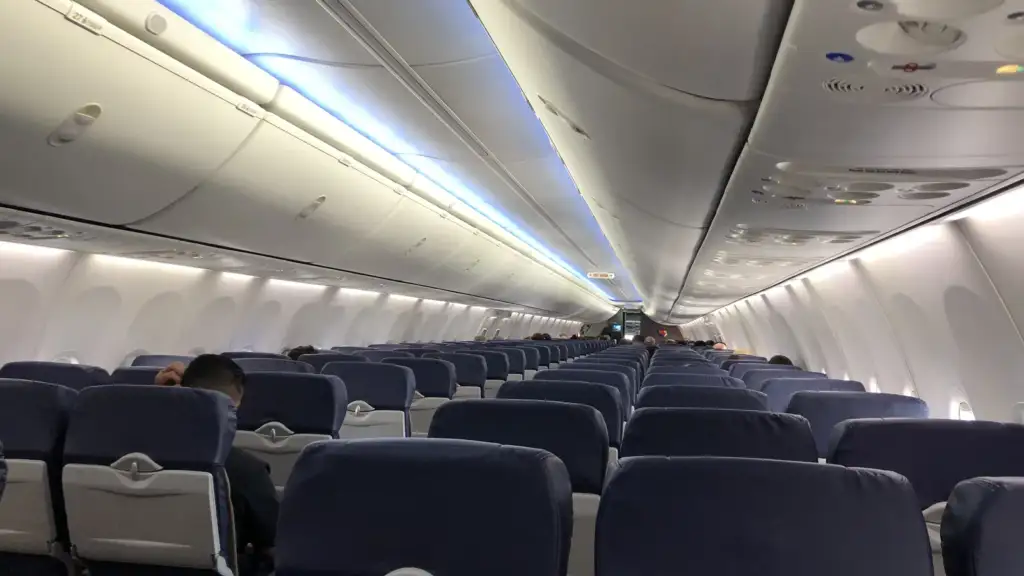
Photo credit: Aircraft Cabin 1 2019-11-28 by FASTILY, CC BY-SA 4.0, via Wikimedia Commons.



Join the discussion