
The old advice on how to spot a fake watch was a list of visible mistakes: a ticking second hand, a misspelled word on the dial, a case that felt too light. Good counterfeits stopped making those mistakes some time ago. What has not changed is that a fake has to be cheap to produce, and the things that are expensive to reproduce are the movement, the published legal criteria behind a label, and a verifiable chain of ownership. Those are where the useful checks now live.
Updated October 2026. General consumer information, not an authentication service and not legal advice. Only the manufacturer or an authorised service centre can confirm a watch is genuine.
The scale of the problem, in the industry’s own figures
The Federation of the Swiss Watch Industry states that tens of millions of fake Swiss watches are offered for sale every year, against Swiss production of around 30 million genuine watches. It puts watches at 9 per cent of customs seizures, second only to textiles. At a single destruction operation at Koniz near Bern in October 2025, 1.5 tonnes of counterfeits, roughly 7,500 watches, were destroyed. The Federation’s president Yves Bugmann summarised the case against them in seven words: “Counterfeit watches threaten innovation and jobs in Switzerland.”
One legal point is easy to miss and expensive to learn. The Federation notes that in Switzerland, as in many other countries, importing a counterfeit watch is forbidden by law even for a single piece bought in good faith for private use. A fake is not simply a bad purchase; it can be seized.
How to spot a fake watch by its movement
Open the case, or have a watchmaker open it, and you have moved the argument onto ground counterfeiters cannot afford. A dial, a case and a bracelet can be copied convincingly for a small fraction of the real price. A genuine in-house movement, with its own finishing, engraving, jewel layout and component geometry, cannot. Replicas therefore fit generic automatic movements and hope nobody looks.
If opening it is not possible, timekeeping is the next best proxy. The Official Swiss Chronometer Testing Authority, COSC, founded in 1973, tests mechanical movements over 15 days in five positions at three temperatures, 8C, 23C and 38C, against seven eliminatory criteria defined by ISO 3159. A certified chronometer must keep time between minus 4 and plus 6 seconds a day. If a watch is sold as a certified chronometer and drifts far outside that window over a week on your wrist, something is wrong with either the watch or the claim.
7 smart checks before you pay
- Look at the movement first, not the dial. The dial is the cheapest part to copy and the movement is the dearest.
- Test the Swiss made claim against the law. The Swiss ordinance requires at least 60 per cent of manufacturing costs to be incurred in Switzerland, technical development in Switzerland, a Swiss movement cased up in Switzerland and final inspection by the manufacturer in Switzerland.
- Check what a Swiss movement means. Assembled and inspected in Switzerland, technically developed there, at least 60 per cent of its manufacturing costs generated there, and Swiss components worth at least 50 per cent of the total excluding assembly.
- Time it over days, not seconds. Compare the rate against the tolerance the model is actually sold under, such as the COSC minus 4 to plus 6 seconds a day.
- Treat the serial number as a lead, not proof. Numbers are copied from genuine watches, so a number that checks out proves only that the number exists.
- Buy the seller. A written authenticity undertaking, a return window you can actually use, an in-house watchmaker and a traceable history are worth more than any inspection you can do in a shop.
- Check the law where the parcel lands. Importing a counterfeit is illegal in many countries even for personal use, and good faith is not a defence against seizure.
Why the classic tells stopped working
- The sweeping second hand. Replicas now fit automatic movements, so the hand sweeps.
- Weight. Correct case materials are cheap enough that fakes feel right in the hand.
- Spelling and print. Gross errors are rare now. Fine printing under magnification still separates good from very good, but it needs a loupe and a reference piece.
- The box and papers. Packaging is the easiest thing in the chain to counterfeit, which is why paperwork alone proves very little.
- Price. A plausible discount is part of the sales pitch. Compare against real transaction prices, not the recommended retail price.
What to do if you think you already own one
Stop wearing it, keep the listing, the invoice and the messages, and open a dispute with the payment provider or marketplace before any return window closes. Then take it to an authorised service centre or an independent watchmaker for an opinion in writing. The pattern is the same as other second-hand markets: evidence and a paper trail decide the outcome. Our guides to spotting fake reviews and inspecting a used car cover the same discipline applied elsewhere, and how product recalls work explains the formal side of a product that should not be in circulation.
Common questions
Can you spot a fake watch without opening the case? Sometimes, from fine print quality under magnification and from timekeeping measured over several days against the tolerance the model is sold under. The movement remains the decisive evidence.
Does a sweeping second hand prove a watch is genuine? No. Modern replicas use automatic movements, so the hand sweeps in the same way. It is one of the tells that stopped working.
What does Swiss made legally require? At least 60 per cent of manufacturing costs incurred in Switzerland, technical development there, a Swiss movement cased up in Switzerland and final inspection by the manufacturer in Switzerland.
How accurate should a certified chronometer be? COSC certification requires a mean daily rate between minus 4 and plus 6 seconds, measured over 15 days in five positions at three temperatures under ISO 3159.
Is it illegal to buy a counterfeit watch? The Federation of the Swiss Watch Industry notes that importing one is forbidden in Switzerland and many other countries, even a single piece bought in good faith for private use. Check your own jurisdiction.
Sources and further reading
Where the figures and rules above come from, so you can check them:
- Volume of fakes offered for sale, share of customs seizures, and the law on importing counterfeits: Federation of the Swiss Watch Industry, stop the fakes
- The October 2025 destruction operation, the quantity destroyed and the quotation: SWI swissinfo.ch, major operation to destroy fake Swiss watches
- Test duration, positions, temperatures, the seven criteria and the rate tolerance: COSC, frequently asked questions
- The legal criteria for Swiss made and for a Swiss movement: Swiss made designation for watches
- The ordinance and guide the criteria come from: Federation of the Swiss Watch Industry, Swiss made
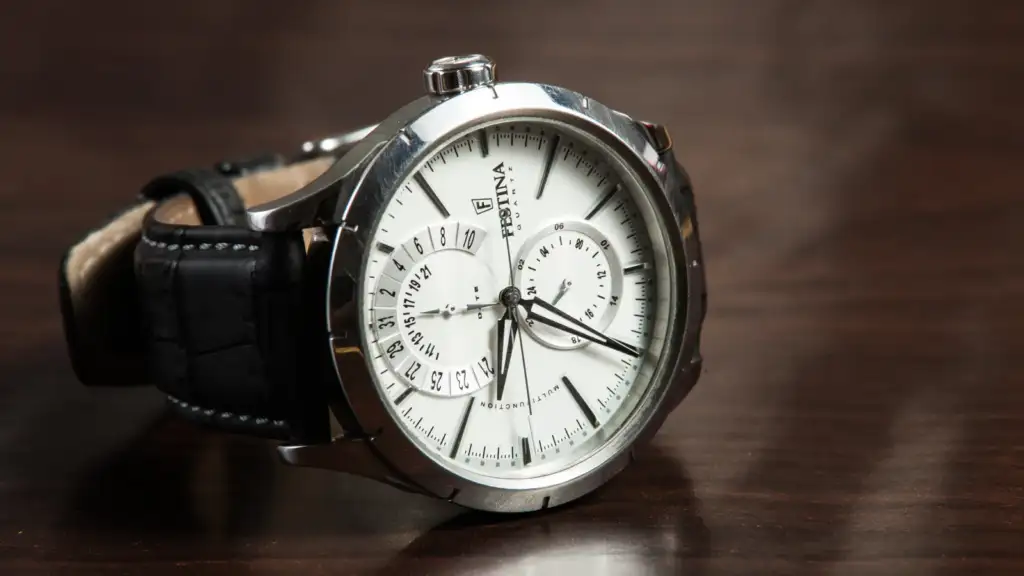
Photo credit: Fashion-wristwatch-time-watch (24217032812) by www.Pixel.la Free Stock Photos, CC0, via Wikimedia Commons.


Join the discussion