
Water filters are bought largely on packaging, and the categories genuinely do different jobs, so the useful question is never which filter is best but which problem you are trying to solve. A carbon cartridge that improves taste does nothing about nitrate. A reverse osmosis system that removes dissolved solids also removes calcium and wastes water. This guide explains how water filters work mechanically, the five main technologies, the certification standards that make a claim checkable, and the limitation each type carries.
Updated October 2026. General information, not health or medical advice. Start from your own water quality report or a certified lab test rather than from a product page.
Start with what is actually in your water
The US Environmental Protection Agency’s WaterSense guide to selecting water treatment systems makes the sequence explicit: find out your water quality, decide your treatment goal, then choose a technology. Under the Safe Drinking Water Act the EPA sets legal limits on more than 90 contaminants, and homes on a public system should receive a consumer confidence report each summer with state certified lab results compared against the national primary drinking water regulations. Homes on a well get no such report and should be tested periodically by a state certified lab.
The guide is also blunt about a trap. Taste and smell are not necessarily a sign of poor water quality, because most harmful contaminants do not affect either. A chlorine smell usually means the utility is disinfecting, and the guide notes you can reduce it free by leaving water in an open pitcher in the refrigerator for a day or two. Buying one of the water filters below because the water tastes odd is a reasonable comfort decision, not a health decision.
5 types of water filters and what each is good for
- Filtration, usually activated carbon. A physical barrier plus carbon or resin that traps contaminants. The EPA lists it as relatively inexpensive, good for taste and odour and organic contaminants, with some able to reduce chlorination byproducts, cleaning solvents and pesticides. It consumes no water. Its listed limitation is important: it does not remove nitrates, bacteria or dissolved minerals. Look for NSF/ANSI 42, 53 and 401.
- Reverse osmosis. Pressure forces water through a membrane that rejects contaminants, producing treated water and a reject stream. The EPA credits it with removing sodium, dissolved inorganics and organics, and says some systems reduce nitrates, pesticides, dioxins, chloroform and petrochemicals. It also removes beneficial minerals such as calcium and can be costly to install and maintain. Look for NSF/ANSI 58.
- Distillation. Water is boiled and the vapour condensed into a separate container, leaving most chemical contaminants behind. The EPA lists removal of nitrates, bacteria, viruses, pathogens, sodium, hardness, dissolved solids, most organic compounds, heavy metals and radionuclides, and notes it can be used during a boil water advisory. It misses some volatile organic compounds and solvents, is energy intensive, and bacteria may grow on cooling coils when idle. Look for NSF/ANSI 62.
- Ultraviolet treatment. Water passes a chamber with a UV lamp that inactivates bacteria, viruses and protozoa. It consumes no water and does nothing at all about chemicals, heavy metals or organics, so it is a companion to a filter rather than a replacement. Look for NSF/ANSI 55.
- Softening and ion exchange. For hardness rather than health. Cation exchange softeners remove excess calcium and magnesium but consume water during regeneration and discharge salts, which is why some jurisdictions restrict them. Look for NSF/ANSI 44.
Why certification is the only claim on water filters you can verify
Performance claims printed on water filters are testable only if a third party tested them. The EPA’s guidance is to look for certification to the applicable NSF/ANSI standards for the contaminant you care about, and to check the performance data sheet or the certification body’s directory to confirm the specific reduction claim. Combined systems carry several standards at once, so a reverse osmosis unit with pre-filters and a UV stage might list NSF/ANSI 42, 53 or 55 alongside 58.
Lead is the clearest worked example. The EPA set an action level of 15 parts per billion, and its 2024 Lead and Copper Rule Improvements require water systems to identify and replace lead pipes within ten years, with more rigorous testing and a lower threshold for action. For households, its advice is to use a filter certified to remove lead, used according to directions, with cartridges replaced before they expire, because an expired cartridge is less effective. Its consumer guidance points to NSF/ANSI 53 for lead reduction, with NSF/ANSI 42 Class I particulate reduction as an additional thing to look for.
PFAS, and an honest caveat about certification
The EPA finalised national primary drinking water regulations for PFAS on 10 April 2024, setting enforceable maximum contaminant levels of 4.0 parts per trillion for PFOA and for PFOS, 10 parts per trillion for PFHxS, PFNA and HFPO-DA, and a hazard index of 1 for mixtures. Its home filter fact sheet names three technologies that can be effective: granular activated carbon, reverse osmosis and ion exchange resins, and tells readers to check packaging for certification to NSF/ANSI 53 or 58 for PFAS reduction, using the certification body’s directory if in doubt.
The same fact sheet contains a caveat almost no product page mentions: as of April 2024 the certification standards for PFAS filters did not yet show that a filter would remove PFAS down to the levels the EPA had just set, and the agency said it was working with standard-setting bodies to update them. Reducing PFAS is still an effective way to limit exposure; claiming a certified filter meets the new regulatory limit is not supported. The EPA has also since proposed changes to parts of this rule, so check the current position for your own water system.
Five habits that matter more than the brand
- Match the filter to a named contaminant, taken from your consumer confidence report or a lab test, not from a guess.
- Read the performance data sheet, not the box. The claim you need has to be listed by name.
- Change cartridges on schedule. The EPA states that unmaintained systems may make water quality worse, and that an expired cartridge is less effective.
- Account for water waste. The EPA estimates a typical point of use reverse osmosis system generates at least five gallons of waste per gallon of treated water, with inefficient models up to ten, while WaterSense labelled models generate 2.3 gallons or less.
- Treat only what you drink and cook with. The guide advises against oversizing and notes that flushing toilets and washing clothes need no extra treatment.
Point of use water filters sit at the tap: pitcher, faucet mounted, refrigerator, faucet integrated, countertop or under sink. Point of entry means whole house, which the EPA says generally costs several thousand dollars to install and suits sources with consistent and significant contamination. If you are weighing filtered tap water against bottled, our piece on whether reusable water bottles help covers that trade, and protecting yourself from air pollution applies the same source-first logic to indoor air.
Common questions
Do water filters remove bacteria? Ordinary carbon filtration does not. The EPA lists filtration as not removing nitrates, bacteria or dissolved minerals. Distillation and ultraviolet treatment address microbiological contaminants; UV does nothing about chemicals.
Is reverse osmosis the best option? It is the broadest, not the best for every case. It removes dissolved inorganics and organics but also strips beneficial minerals such as calcium, costs more to install and maintain, and wastes water.
How much water does reverse osmosis waste? The EPA estimates at least five gallons of waste per gallon of treated water for a typical point of use system, and up to ten for inefficient models. WaterSense labelled systems generate 2.3 gallons or less per gallon produced.
Which standard should I look for on the box? NSF/ANSI 42 for aesthetic effects such as chlorine taste and odour, 53 for health related contaminants including lead, 401 for emerging compounds, 58 for reverse osmosis, 55 for UV, 62 for distillation and 44 for softeners.
Will a filter get PFAS below the legal limit? Not demonstrably. The EPA’s home filter fact sheet states that as of April 2024 the certification standards did not yet indicate that a filter removes PFAS to the levels set in its drinking water standard, while still describing reduction as an effective way to limit exposure.
Sources and further reading
Where the figures and rules above come from, so you can check them:
- Technology table, NSF/ANSI standards, water waste and maintenance: EPA WaterSense Guide to Selecting Water Treatment Systems, November 2024
- PFAS maximum contaminant levels and the April 2024 rule: US Environmental Protection Agency
- Home filter technologies for PFAS and the certification caveat: EPA, Reducing PFAS in Your Drinking Water with a Home Filter
- Lead action level, filter advice and cartridge expiry: US Environmental Protection Agency
- Lead pipe replacement and lower action threshold: EPA Lead and Copper Rule Improvements
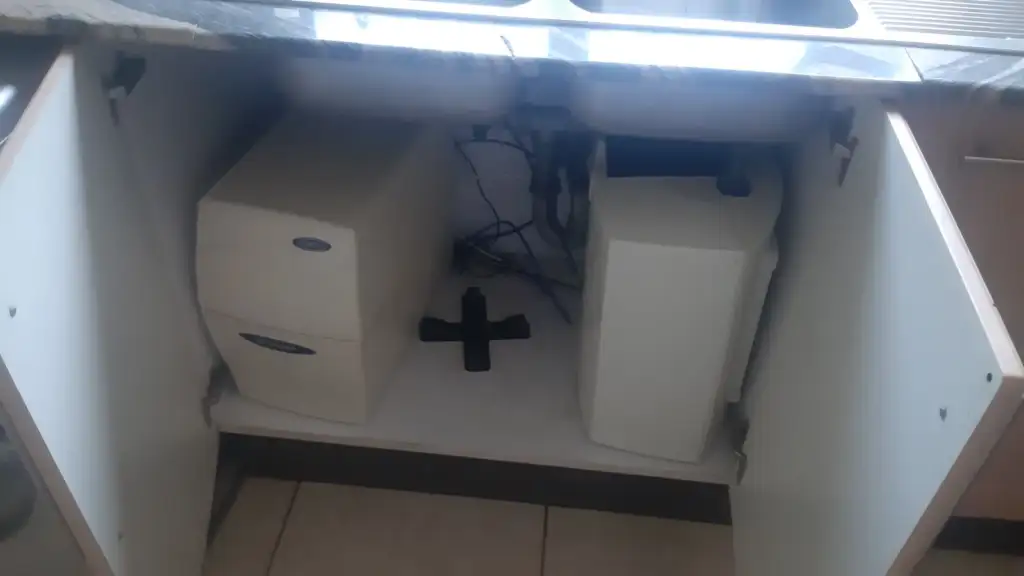
Photo credit: Under-sink Water Filter System by Fanti Salms, CC BY-SA 4.0, via Wikimedia Commons.
Seasonal conditions decide a lot about water supply. See our guide to the winter weather forecast.


Join the discussion