

The Mac vs PC gaming argument is usually fought over silicon, and silicon is the part that has moved on. What has not moved nearly as far is the catalogue, the anti-cheat position and the fact that a Mac’s memory is fixed on the day you order it. This is a comparison of published specifications and published platform rules, not a verdict on frame rates, because frame rates depend on the exact machine and settings in front of you.
Updated October 2026. Platform shares, system requirements and hardware configurations are quoted from the sources listed below and change frequently. No performance testing is claimed here.
Mac vs PC gaming: what the platform numbers show
Valve’s Steam Hardware and Software Survey is the largest regularly published census of the machines people actually game on. In the August 2026 results, Windows accounted for 93.95 per cent of surveyed systems, Linux for 3.90 per cent and macOS for 2.14 per cent. Within Windows, 64-bit Windows 11 was on 70.97 per cent of systems and 64-bit Windows 10 on 22.90 per cent.
That share is the reason the catalogue looks the way it does. Publishers build and test against the platform most of their buyers use, so a Mac release is a business decision taken per title rather than a technical inevitability. It also explains why the gap shows up most sharply in day-one releases and in competitive multiplayer, and least in games that were already cross-platform.
What Apple now ships for games
Apple’s developer material describes Metal as giving direct, low-overhead control of the GPU across Apple silicon, and MetalFX as upscaling lower resolution content to save GPU time. Game Porting Toolkit, now at version 4, is pitched at developers as a way to evaluate how an existing Windows game will run on a Mac and to convert shaders and graphics work. The Games app collects games across iPhone, iPad and Mac in one place.
Read that list carefully and the shape of the situation is clear. Apple is investing in making porting cheaper for studios, which is a supply-side fix with a lag. It is not a promise that any particular title will arrive.
The routes to Windows games on a Mac, and their limits
Translation layers are the usual answer. CrossOver, currently at version 26, describes itself as translating Windows commands into Mac commands so Windows software runs without a separate Windows installation, and it is explicitly not an emulator. Cloud streaming is the other route: NVIDIA lists GeForce NOW support for macOS 10.15 or higher on any Mac introduced in 2009 or later, and publishes the bandwidth it wants, including 25 Mbps for 1080p at 60 frames per second and 45 Mbps for 4K at 120.
Both routes stop at the same wall, and it is a rules wall rather than a performance one. Competitive titles with kernel level anti-cheat simply do not list macOS. Riot’s published specifications for Valorant require 64-bit Windows 10 build 19041 or later, or Windows 11, and on Windows 11 they additionally require TPM 2.0 and UEFI Secure Boot. There is no Mac entry to translate.
Memory you cannot change later
On a desktop PC the graphics card and the RAM are replaceable parts. On a Mac, unified memory is specified at purchase and stays there. Apple’s current comparison lists the MacBook Air with M5 from 16 GB of unified memory and an 8-core GPU, the 14-inch MacBook Pro with M5 at 16 GB and a 10-core GPU, M5 Pro models from 24 GB with 16 GPU cores, and M5 Max models from 36 GB with 32 GPU cores and up to 128 GB.
For comparison, Microsoft’s published Windows 11 minimum requirements are modest on paper, at 4 GB of RAM, 64 GB of storage, a DirectX 12 capable GPU with a WDDM 2.0 driver, TPM 2.0 and UEFI Secure Boot capability. The practical point is not the minimum but the ceiling: on a PC you can raise it later, and on a Mac the configuration you choose today is the configuration you keep. If you are pricing a tower, our guides to prebuilt or custom gaming PCs and building a cheap gaming PC cover that side.
5 honest trade-offs worth knowing
- Catalogue against curation. Windows holds the broad library, with 93.95 per cent of surveyed Steam systems. A Mac library is smaller and arrives later, title by title.
- Translation against certainty. A compatibility layer runs a great deal, but no layer can satisfy an anti-cheat system that requires Windows features at boot.
- Fixed memory against upgrade paths. Unified memory is chosen once. PC RAM and graphics cards are replaceable, which spreads the cost over years.
- One machine against one purpose. A Mac that already earns its keep for work is cheap gaming capacity. A dedicated PC is cheaper gaming capacity per pound and worse at everything else you were going to buy anyway.
- Local against streamed. Cloud streaming removes the platform question and replaces it with a bandwidth and latency question, with published requirements of 25 Mbps at 1080p60 and 45 Mbps at 4K120.
How to decide without guessing
Make a list of the five games you expect to play this year and check each one’s own system requirements page for a macOS entry and for an anti-cheat note. If all five list macOS, the Mac vs PC gaming question is already answered for you. If two of them are competitive shooters with kernel anti-cheat, no amount of Apple silicon will change the answer, and a Windows machine is the honest purchase. If you want a portable machine either way, new against refurbished gaming laptops is the next decision.
Common questions
What share of gaming machines run macOS? In Valve’s Steam Hardware and Software Survey for August 2026, macOS was 2.14 per cent of surveyed systems, Windows 93.95 per cent and Linux 3.90 per cent.
Can I run Windows games on a Mac? Often, through a translation layer such as CrossOver, which converts Windows calls rather than emulating a PC, or by streaming. Neither helps with titles whose anti-cheat requires Windows features.
Why are competitive shooters missing on Mac? Their published requirements are Windows only. Valorant, for example, lists 64-bit Windows 10 build 19041 or later or Windows 11, and requires TPM 2.0 and UEFI Secure Boot on Windows 11.
Can I add memory to a Mac later? No. Unified memory is configured at purchase. Apple lists MacBook Air and 14-inch MacBook Pro M5 models from 16 GB, M5 Pro from 24 GB and M5 Max from 36 GB up to 128 GB.
Is cloud streaming a real alternative? It is a genuine route on a Mac. NVIDIA lists GeForce NOW support from macOS 10.15 and asks for 25 Mbps for 1080p at 60 frames per second and 45 Mbps for 4K at 120.
Sources and further reading
Where the figures and rules above come from, so you can check them:
- Operating system shares for August 2026: Steam Hardware and Software Survey, Valve
- Metal, MetalFX, Game Porting Toolkit 4 and the Games app: Apple Developer
- What CrossOver does and the current version: CodeWeavers
- Published system requirements and the Windows 11 TPM and Secure Boot requirement: Riot Games, Valorant specifications
- Unified memory and GPU core options by chip: Apple, compare Mac models
- Supported devices, macOS versions and bandwidth requirements: NVIDIA GeForce NOW
- Windows 11 minimum system requirements: Microsoft
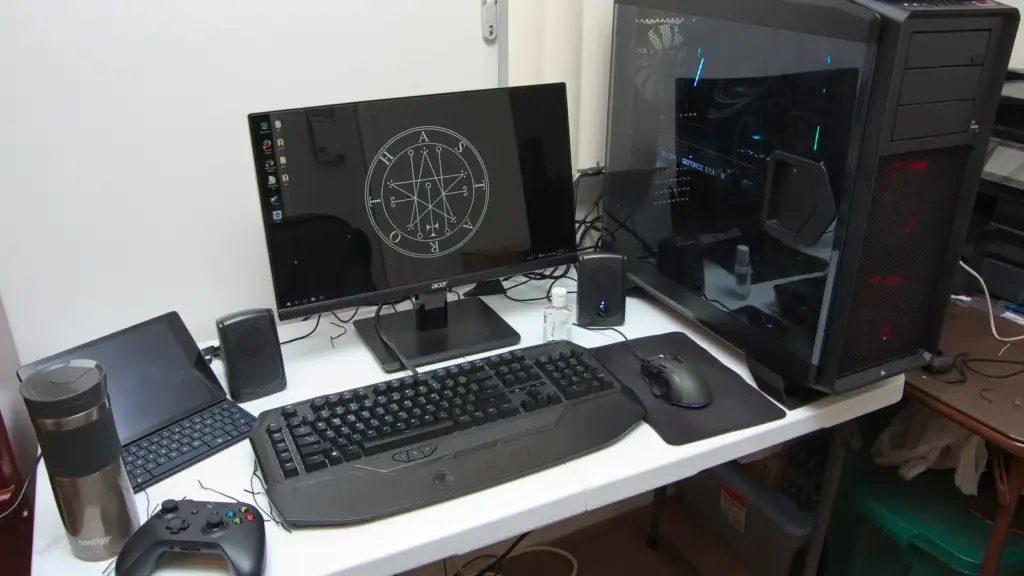
Photo credit: Gaming PC-Setup – Astaroth- The Completed System by Brian Wong, CC BY-SA 2.0, via Wikimedia Commons.



Join the discussion