

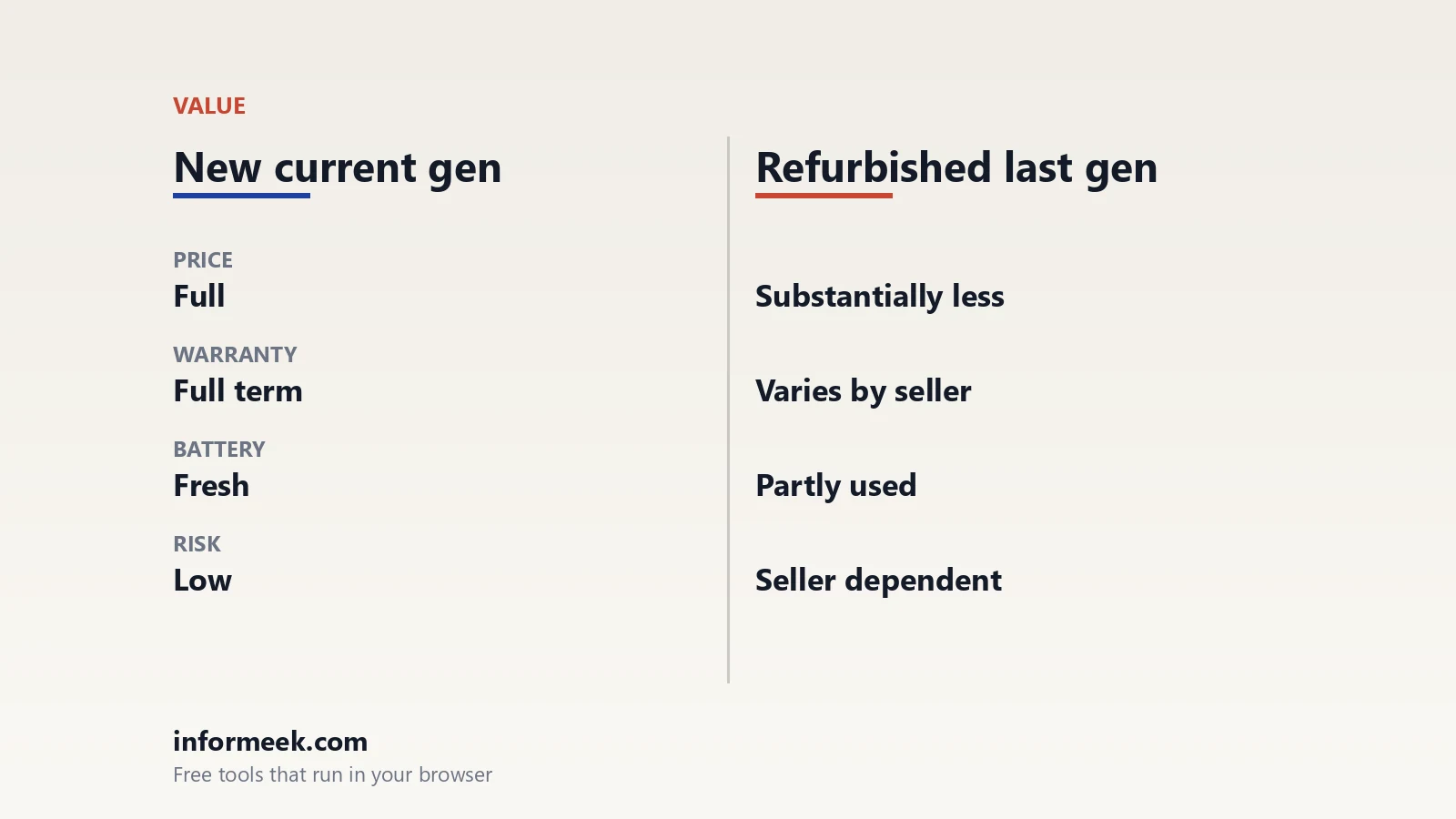
A refurbished gaming laptop is often the better machine for the money than a new budget one, and occasionally a trap, and the difference is almost never the age of the hardware. It is who refurbished it, what they tested, what rights you have afterwards, and one specification that most listings quietly omit. All four can be checked before you pay, using documents the manufacturers and regulators publish.
Updated October 2026. Specifications, warranty terms and consumer rules are quoted from the sources listed below and differ by country, seller and model. This is general information, not legal advice.
Why a refurbished gaming laptop can be the better buy
The specification that decides gaming performance in a laptop is not the graphics chip name. NVIDIA publishes its laptop GPUs with a power range rather than a single figure, and the current GeForce RTX 50 series comparison lists a GPU subsystem power of 95 to 150 W for the RTX 5090 laptop GPU, 80 to 150 W for the 5080, 60 to 115 W for the 5070 Ti, 50 to 100 W for the 5070, 45 to 100 W for the 5060 and 35 to 100 W for the 5050.
Read those ranges again. The same model name can be configured with roughly a third more power in one chassis than another, and NVIDIA directs buyers to the laptop manufacturer for the specific configuration. That is why a well cooled previous generation machine can be the stronger buy against a thin new one carrying a newer badge, and it is also why the comparison has to be done model by model rather than tier by tier. Our look at the RTX 5050 against the RTX 5060 and at 16-inch against 15-inch chassis covers the cooling side of that trade.
What refurbished has to mean before it is low risk
The word is unregulated in ordinary use, so look at what the seller commits to. Apple’s description of its Certified Refurbished programme is a useful benchmark for the standard worth insisting on: full functional testing, genuine replacement parts as needed, thorough cleaning and inspection, all accessories and cables, the operating system installed, new packaging, and a standard one year limited warranty, with iOS devices receiving a new battery and outer shell.
Against that, a listing that says only used, tested and working is a different product at a similar price. The practical rule is that manufacturer or large retailer refurbishment with a stated warranty length is a low risk purchase, and an individual seller’s description is an unpriced risk you are absorbing.
Your legal position is not the seller’s promise
In the EU, goods bought from a professional seller carry a minimum two year period in which you can require a remedy, and this applies to second-hand goods as well as new ones. If a defect appears within the first year you do not have to prove it was there at delivery, and some member states extend that presumption across the full two years. Some countries allow the period to be reduced to one year for second-hand goods if that is agreed explicitly at the time of purchase, which is exactly the kind of clause worth reading before you click.
Two things follow. A private sale generally sits outside those protections, so the saving has to be large enough to cover the risk yourself. And a seller’s own warranty is additional to your statutory position, not a substitute for it, so a thirty day shop guarantee does not shorten your legal rights against a professional seller.
The software deadline hiding in a cheap used machine
Microsoft’s published Windows 11 requirements are a 64-bit processor with two or more cores at 1 GHz or faster, 4 GB of RAM, 64 GB of storage, UEFI with Secure Boot capability, TPM version 2.0, a DirectX 12 compatible GPU with a WDDM 2.0 driver, and a 720p display larger than nine inches. Support for Windows 10 ended on 14 October 2025.
That makes the TPM and Secure Boot line the first thing to check on anything older, because a machine that cannot take Windows 11 is a security dead end rather than a bargain. It also matters for games specifically: Riot’s published specifications for Valorant require TPM 2.0 and UEFI Secure Boot on Windows 11, so an older laptop can fail an anti-cheat check even when its graphics are ample.
7 checks for a safe buy
- Ask who refurbished it. Manufacturer, large retailer or an unnamed third party. This single answer drives most of the risk.
- Get the warranty in writing, with a length. Apple’s programme, for example, states a one year limited warranty. Anything vaguer is a gap.
- Confirm your statutory position. A professional seller in the EU owes you a minimum two year remedy period even on second-hand goods. A private seller usually does not.
- Check the graphics power, not the model name. Ask for the maximum graphics power for that exact laptop and compare it with NVIDIA’s published range for the GPU.
- Check Windows 11 eligibility. TPM 2.0 and Secure Boot capability, since Windows 10 support ended on 14 October 2025.
- Ask for the battery figures. Cycle count and current capacity against original. Batteries are consumables and the one part you cannot judge from a photograph.
- Price the parts you may replace. Battery, fans and thermal paste on an older machine, against the cost of the new budget laptop you are comparing it with.
Apply the same list to a new machine and most of it still works, which is the point. If you are weighing the whole category rather than one listing, how to choose a laptop covers the basics, and speeding up an old laptop is worth trying before you replace anything.
Common questions
Is a refurbished gaming laptop reliable? It depends on the refurbisher. Manufacturer or large retailer programmes state what was tested and how long the warranty runs, as Apple does with full functional testing, genuine replacement parts and a one year limited warranty. An unspecified used listing carries the risk instead.
What warranty do I get on second-hand goods in the EU? From a professional seller, a minimum two year period in which you can require a remedy. Within the first year you do not have to prove the defect existed at delivery, and some countries allow the period to be cut to one year for second-hand goods if agreed explicitly.
Why do two laptops with the same GPU perform differently? Because laptop GPUs ship with a power range. NVIDIA lists the RTX 5070 laptop GPU at 50 to 100 W of GPU subsystem power, for example, and refers buyers to the laptop maker for the specific configuration.
Does an older laptop still run Windows 11? Only if it meets the published requirements, which include TPM 2.0 and UEFI Secure Boot capability. Windows 10 support ended on 14 October 2025, so an ineligible machine stops receiving updates.
How much should a refurbished machine save me? Enough to cover what you are giving up. If the warranty is shorter and the battery is older, the discount has to pay for a battery and the risk you are taking on, otherwise a new machine with full rights is the better purchase.
Sources and further reading
Where the figures and rules above come from, so you can check them:
- GPU subsystem power ranges for current laptop GPUs: NVIDIA, compare GeForce RTX laptops
- What a Certified Refurbished product includes, including warranty length: Apple
- Minimum two year remedy period, second-hand goods and the burden of proof: Your Europe, European Commission
- Windows 11 minimum requirements and the end of Windows 10 support: Microsoft
- TPM 2.0 and Secure Boot requirement for an anti-cheat protected game: Riot Games, Valorant specifications
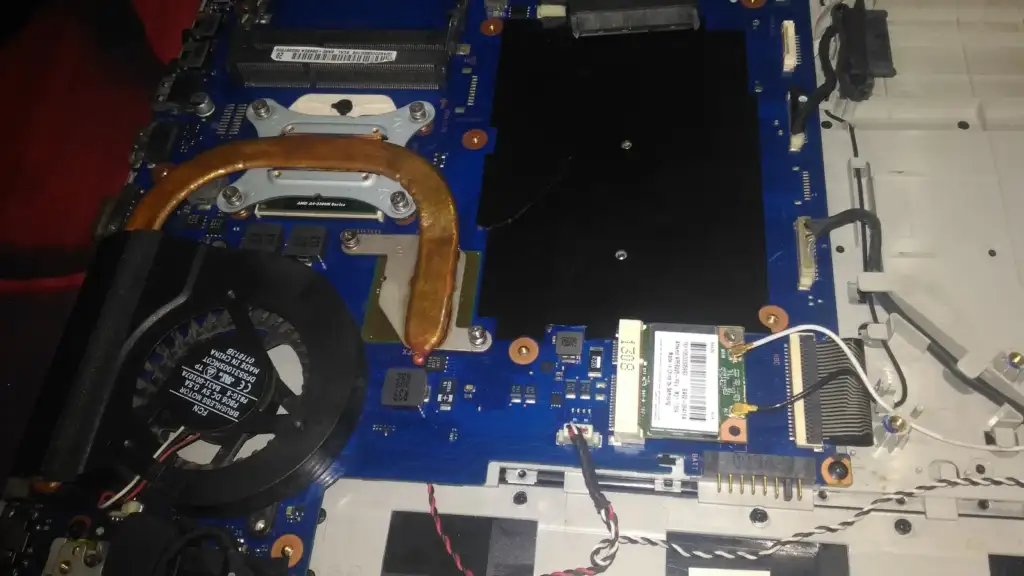
Photo credit: Laptop open servicing by Solutionservice21, CC BY-SA 4.0, via Wikimedia Commons.


Join the discussion