

NFL contracts are reported as single enormous numbers and almost never pay out that way. A deal described as five years and 150 million dollars may be, in practice, a two year agreement with an option attached. The reason is the salary cap, and specifically the accounting rules in the collective bargaining agreement that decide when money counts, how it is spread and what happens to it when a player is released. Once those rules are clear, most of the roster decisions that look irrational make straightforward financial sense.
Updated October 2026.
The cap is a hard ceiling, and here is the 2026 number
The cap is not a tax or a soft target. The collective bargaining agreement states plainly that “No Club may have a Team Salary that exceeds the Salary Cap”. Every roster decision happens inside that constraint, which is why a productive player can be released while a less productive one stays.
For the 2026 season the cap is 301.2 million dollars per club, the first time the figure has passed 300 million. That is a rise of 22 million dollars on the 279.2 million dollar cap of the previous year. Benefits sit on top of it: the league put those at a further 77.6 million dollars per club, taking total player spending to 378.8 million dollars per team.
How NFL contracts are counted against the cap
Four mechanics do most of the work. Paragraph 5 salary, the base salary line in the standard player contract, is included in Team Salary in the year earned. A signing bonus is paid up front in cash but prorated over the term of the contract on a straight-line basis, with a maximum proration of five years. Incentives are counted in a league year if they are classed as likely to be earned. And a roster bonus can be treated like a signing bonus in defined circumstances, including in the season of signing when a contract is signed after the last preseason game.
That five year proration limit is the single most important number in the structure of modern NFL contracts. It is why deals are written with long nominal terms: more years means more places to park a large signing bonus, up to the five year cap on spreading it.
Does guaranteed money count against the cap?
Yes, but not all at once, and this is where most confusion starts. The agreement provides that any portion of salary for which a team guarantees payment for all of skill, injury and, where applicable, salary cap related termination is included in Team Salary during the year earned. A fully guaranteed salary in the third year of a deal therefore sits on the third year’s cap, not on today’s. Guaranteeing money does not accelerate the cap charge; it removes the team’s ability to walk away without paying.
What does accelerate is unamortised signing bonus. If a contract is terminated before 1 June, the remaining proration is included in Team Salary for that league year. After 1 June, future year proration is included fully at the start of the next league year instead, and each club may designate up to two contracts per year to be treated as though terminated on 2 June. That designation is the whole reason teams announce releases in March with a post-June-1 label attached: it splits the charge across two seasons rather than reducing it.
There is a separate cash rule that explains why fully guaranteed contracts stay rare even though the cap would allow them. Under the funding provisions, a club must deposit into a segregated account the present value of deferred and guaranteed compensation, less a deductible of 15 million dollars for the 2020 to 2028 league years, rising to 17 million dollars for 2029 and 2030. For guaranteed contracts the unpaid compensation included in that calculation is capped at 75 percent of the total amount. In other words, a guarantee is money a club has to park now, not merely budget for later.
6 rules worth knowing
- The cap is hard. Team Salary may not exceed it, so every signing is also a decision not to sign somebody else.
- Signing bonus proration is capped at five years. Cash is paid now, the cap charge is spread straight-line over at most five seasons.
- Base salary and guaranteed salary count in the year earned. A guarantee shifts risk to the club; it does not pull the charge forward.
- Release before 1 June and the whole remaining bonus lands this year. After 1 June, the future portion moves to the next league year.
- Each club gets two post-June-1 designations a year. It is a timing tool, not a saving, and teams spend those two slots carefully.
- Guarantees must be funded in cash. Present value into a segregated account, less the deductible, with guaranteed contracts counted up to 75 percent.
Reading a reported contract
Ignore the headline total and look for three figures: the signing bonus, the fully guaranteed amount, and the first league year in which the club can release the player without a large acceleration charge. Those three tell you the real length of the agreement. Sport is full of headline numbers that behave like this; our explainers on how football transfer fees work and how sports kit deals work unpick the same gap between announced value and money actually paid. If you are following the season itself, we also cover how to stream live sports.
Common questions
Does guaranteed money count against the salary cap? Yes, in the year it is earned. Salary guaranteed for skill, injury and cap related termination is included in Team Salary during that year, so a guarantee in a later season sits on that season cap rather than the current one.
What is the NFL salary cap for 2026? 301.2 million dollars per club, up 22 million from 279.2 million. With a further 77.6 million dollars in benefits per club, total player spending is 378.8 million dollars per team.
Why are signing bonuses spread over several years? The agreement prorates a signing bonus over the contract term on a straight-line basis with a maximum proration of five years. The cash is paid immediately; only the annual slice counts against the cap.
What does a post-June-1 designation do? It lets a club treat a release as though it happened on 2 June, so only the current year proration counts now and the rest moves to the next league year. Each club may designate up to two contracts per year.
Why are fully guaranteed NFL contracts so rare? Because guarantees have to be funded. A club must deposit the present value of guaranteed compensation into a segregated account, less a deductible of 15 million dollars for 2020 to 2028, with guaranteed contracts counted up to 75 percent of the total.
Sources and further reading
Where the figures and rules above come from, so you can check them:
- 2026 salary cap, 2025 comparison, benefits and total player spending: NFL.com
- Article 13: the cap as a hard limit, proration and the June 1 rules: NFL Collective Bargaining Agreement text
- Article 13 Section 6: salary, guarantees and incentives counted in Team Salary: NFL Collective Bargaining Agreement text
- Article 26: funding of deferred and guaranteed compensation: NFL Collective Bargaining Agreement text
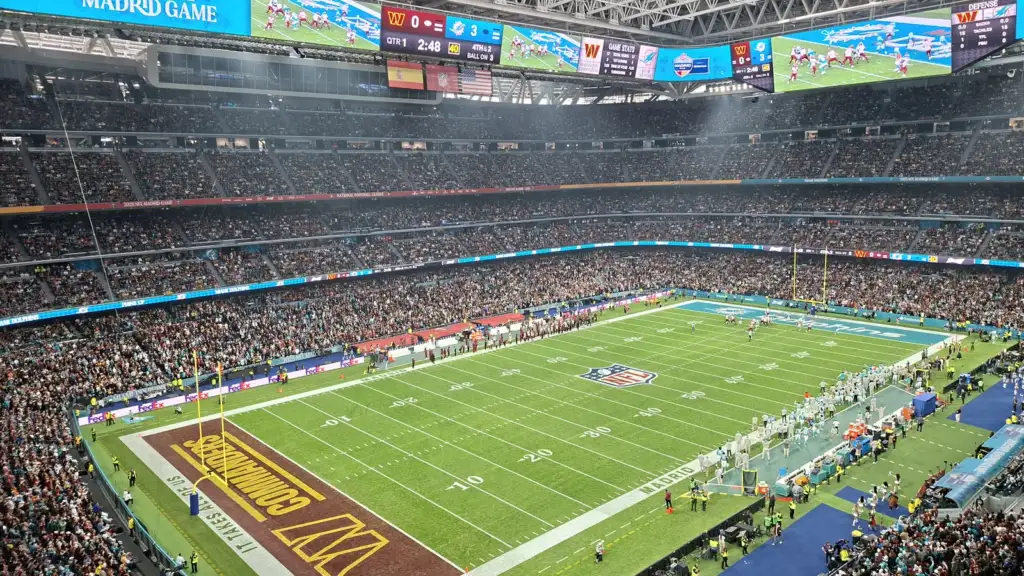
Photo credit: 2025 NFL Madrid Game 1 by Badefa, CC0, via Wikimedia Commons.


Join the discussion