
How many players on a soccer team is a question with a quick answer and several longer ones. On the field, each side has 11 players, one of whom is the goalkeeper. Around that number sit rules about substitutes, the minimum needed to keep playing, the size of tournament squads and the smaller formats children play. This guide covers each, using the current Laws of the Game.
Updated September 2026. Rules are quoted from the IFAB Laws of the Game 2026/27, which took effect on 1 July 2026. Competitions can set their own limits within those Laws.

The basic rule: 11 per side
Law 3 of the Laws of the Game, published by the International Football Association Board (IFAB), says a match is played by two teams of no more than eleven players each, one of whom must be the goalkeeper. The other ten are outfield players, and how they line up, whether as defenders, midfielders or forwards, is a tactical choice rather than a rule.
The minimum number of players on a soccer team
A match may not start or continue if either team has fewer than seven players. Players can drop out through injuries once all substitutes are used, or through red cards. If a side falls below seven, the referee does not restart play once the ball goes out, and the competition rules decide the result.
Discipline can reach the bench too. Our explainer on what gets a manager sent off covers how team officials are dealt with.
Substitutes under the 2026/27 Laws
How many replacements a team may use depends on the type of match:
- Official competitions (top division clubs and senior national teams): up to 15 substitutes can be named and a maximum of five used. Each team has three substitution opportunities during play, plus half-time.
- Extra time: where competition rules allow, one additional substitute can be used, even if the team has not used its full allowance.
- Concussion substitutes: additional permanent substitutions are allowed under a separate protocol, so a suspected head injury does not cost a team one of its normal changes.
- Senior international friendlies: up to 15 can be named and a maximum of eight used, rising from six in the previous edition. The two teams can agree to use up to eleven.
- Other matches: teams can agree a larger number in advance. Without agreement, the limit is six.
- Return substitutes: players coming back on after being replaced are only permitted in youth, veterans, disability and grassroots football, and only with approval from the relevant football association, confederation or FIFA.
How the limits work in practice
Two examples show how these numbers combine. A coach in a top-division match who brings on two players at 60 minutes, two at 75 and one at 85 has used all five substitutes and all three opportunities. A change made at half-time would not have used up one of those three opportunities, which is why many teams make changes during the interval.
The minimum works the same way. A side that has used every substitute can carry on with injuries and red cards until it reaches seven players on the field. At that point the match can still continue, but losing one more player means it cannot restart. Concussion substitutes are the exception to running out: under the separate protocol, a suspected head injury can be replaced even after the normal allowance is gone.
New for 2026/27: the ten-second exit
One of the changes this season targets time-wasting during substitutions. A player being replaced must leave the field within ten seconds of the substitution board being shown. If they take longer, play restarts without the replacement, who may only enter at the first stoppage after one minute has passed. Other 2026/27 changes include a visible five-second countdown for delayed throw-ins and goal kicks. Technology matters for decisions too, as our guide to semi-automated offside explains.
Squad sizes: why a team has more than 11 players
Clubs register far more players than they can field, to cover injuries, suspensions and fixture congestion. Registration limits are set by each league or tournament rather than by the Laws of the Game.
The clearest recent example is the FIFA World Cup 2026. Each national team had to name a final squad of at least 23 and no more than 26 players, including at least three goalkeepers. From that group, a matchday team still starts with 11 and uses substitutes within the Law 3 limits above.
Youth soccer: fewer players on the field
Children usually play small-sided games with fewer players, on smaller pitches, so everyone touches the ball more often. The numbers depend on the country.
England: the FA’s formats from 2026/27
The Football Association changed its youth pathway from the start of the 2026/27 season as part of its FutureFit programme. Its Know Your Format guide sets out:
- Under 7s: 3v3, a new entry format.
- Under 8s and under 9s: 5v5.
- Under 10s and under 11s: 7v7.
- Under 12s and under 13s: 9v9.
- Under 14s and older: 11v11.
The practical effect is that players stay in smaller formats for longer, with full-sided matches starting a year later than before.
United States: U.S. Soccer standards
In the US, U.S. Soccer’s Player Development Initiatives set small-sided standards for younger age groups:
- Under 8 and younger: 4v4.
- Under 9 and under 10: 7v7.
- Under 11 and under 12: 9v9.
Beyond those age groups, teams move up towards the full game. Local leagues can add their own rules, so check with your club or state association.
Quick reference
- Players on the field per team: 11, including one goalkeeper.
- Minimum to start or continue a match: 7.
- Substitutes in top official competitions: up to 5, with 1 more in extra time where permitted.
- Substitutes in senior international friendlies: up to 8, or 11 by agreement.
- World Cup 2026 squad: 23 to 26 players, at least 3 goalkeepers.
Common questions
How many players are on a soccer team on the field? Eleven per side, including one goalkeeper, under Law 3 of the Laws of the Game.
What is the minimum number of players for a soccer match? Seven. A match may not start or continue if either team has fewer than seven players.
How many substitutes are allowed in soccer? In top official competitions, up to five, using three opportunities plus half-time. Senior international friendlies allow up to eight in 2026/27, or eleven if both teams agree.
How many players were in a World Cup 2026 squad? Between 23 and 26, of whom at least three had to be goalkeepers.
How many players are on a youth soccer team? It depends on age and country. In England from 2026/27, under 7s play 3v3 and 11v11 starts at under 14. In the US, under 8s play 4v4.
Sources and further reading
Where the figures and rules above come from, so you can check them:
- Law 3: The Players, Laws of the Game 2026/27: IFAB
- 2026/27 law changes and effective date: The Referees’ Association
- Know Your Format guide, February 2026: The Football Association
- U.S. Soccer small-sided standards: Eastern Pennsylvania Youth Soccer
- World Cup 2026 roster size rules: FOX Sports
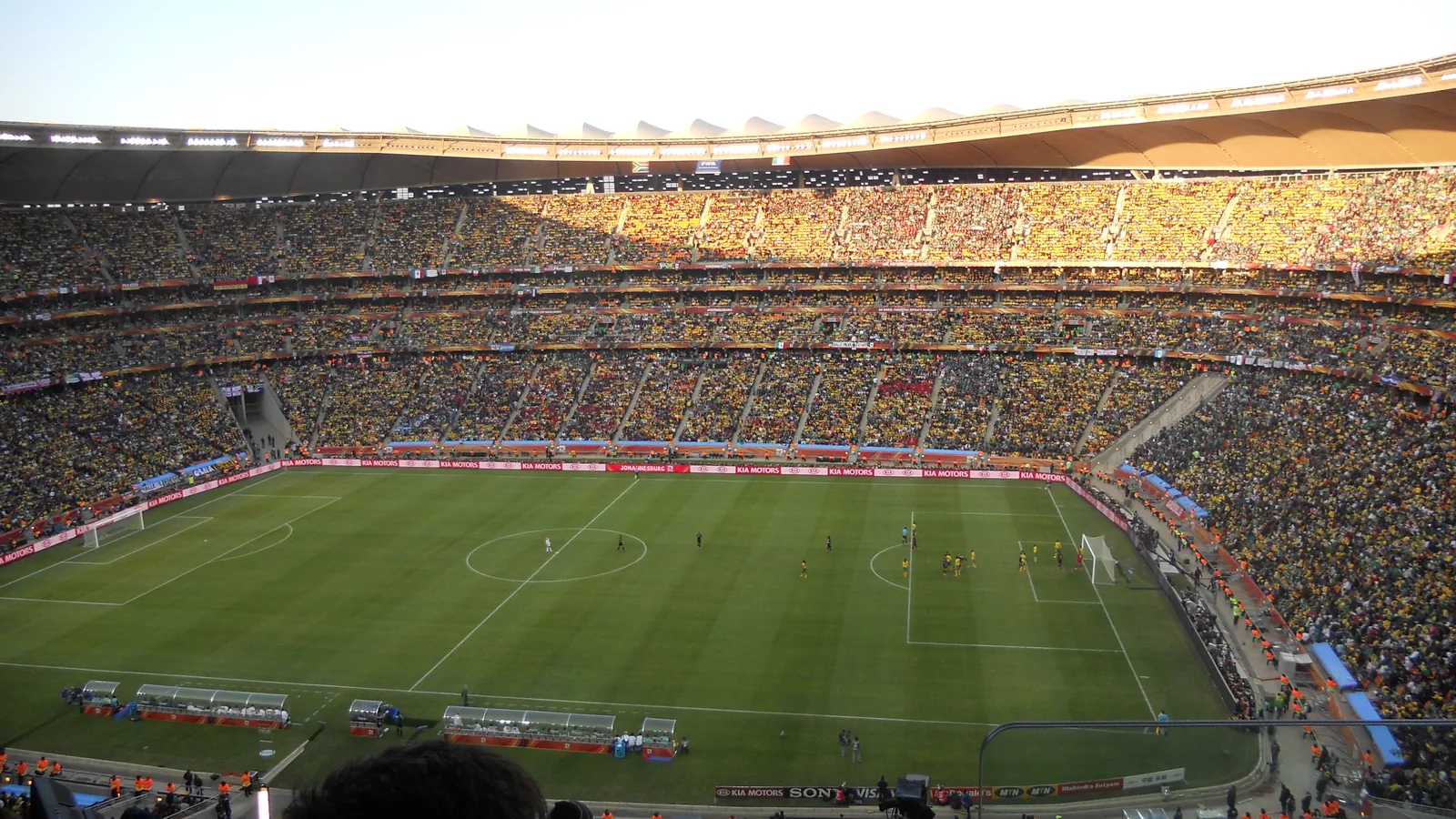
Photo credits: First game of the 2010 FIFA World Cup, South Africa vs Mexico by 2010 World Cup – Shine 2010, CC BY 2.0, via Wikimedia. Soccer Field by Abigail Keenan, CC0, via Stocksnap.
For a sport with far simpler numbers, read our guide to pickleball rules.


Join the discussion