

The Club World Cup format confuses people because it borrows almost nothing from the competitions supporters follow every week. There is no two-legged tie, no away goals question, no table built over nine months. Everything is decided inside a month, in one host country, under a rulebook FIFA publishes in full. This article works from that rulebook, the Regulations for the FIFA Club World Cup 2025.
Updated October 2026. Rules described are those of the 2025 edition as published by FIFA; competition regulations are reissued for each edition.
What the Club World Cup format actually is
Article 1 of the regulations sets the rhythm of the thing. The competition “takes place every four years and participation in the Club World Cup is free of charge”, which separates it immediately from a continental league phase that runs annually. Article 12 then lays out the shape: a group stage, a round of 16, quarter-finals, semi-finals and a final, with a total of 63 matches and no third-place play-off.
Thirty-two clubs are divided into eight groups of four. Each team plays the other three in its group once, with three points for a win, one for a draw and none for a defeat. The top two in every group go through. The last two matches in each group kick off at the same time, which stops a side from knowing exactly what result it needs while its rival is still playing.
The 2025 edition was the first run at this shape. It was played in the United States from 14 June to 13 July 2025 across 12 stadiums in 11 cities, and Chelsea beat Paris Saint-Germain 3-0 in the final. That single-country, single-month structure is why the calendar argument never goes away, a tension our piece on why clubs rest young players looks at from the squad side.
How the 32 places were allocated
This is the part most people get wrong. Qualification is not a reward for last season’s league position. Article 11 states that the 32 teams are the host member association’s representative plus 31 teams that qualified on performance in their confederation’s premier club competition over the period 2021 to 2024, together with the FIFA club ranking announced in December 2023.
The FIFA Council fixed the slots on 14 March 2023: twelve for UEFA, six for CONMEBOL, four each for the AFC, CAF and Concacaf, one for the OFC and one for a host-nation club. Within those slots the principle is the same everywhere. Winners of the confederation’s top club competition between 2021 and 2024 take the places first. UEFA’s eight remaining places and CONMEBOL’s two were filled from the club ranking over the same four years. The OFC place went to the highest-ranked of its champions.
Two further clauses explain most of the apparent unfairness. If a club won the same continental title twice or more in those four years, the surplus places go to the ranking rather than to a second entry. And a cap of two clubs per country applies, with an exception only where more than two clubs from one country won the confederation’s premier competition during the window. That cap is why a strong domestic league can watch its third-best side stay at home.
7 rules worth knowing about the Club World Cup format
- Thirty-two clubs, 63 matches, no third-place play-off. The tournament is shorter than its size suggests because every round after the groups is a single match.
- Places come from four years, not one season. Continental titles won between 2021 and 2024 plus the FIFA club ranking decided the field, so a club can qualify on form it showed three years earlier.
- Two clubs per country, with one exception. The cap lifts only where more than two clubs from the same country won their confederation’s top competition in the window.
- Group order is settled head to head first. Points between the tied teams, then goal difference between them, then goals scored between them, all before overall records are considered.
- Discipline can decide a place. If teams are still level, a conduct score applies: minus one point for a yellow card, minus three for an indirect red, minus four for a direct red and minus five for a yellow plus a direct red.
- Knockout ties finish on the day. Two 15-minute periods of extra time, then penalties under the Laws of the Game. Players stay on the pitch through the five-minute interval before extra time.
- Squads are capped and barely movable. A final list of at least 26 and at most 35 players, at least three of them goalkeepers, with a maximum of 26 named for any single match.
How ties are broken, and why that matters
Article 13 is worth reading closely if you care about what a draw on matchday three means. The first three criteria look only at the matches between the tied teams: points, then goal difference, then goals scored. If teams are still level, those three tests are reapplied to the matches between whichever teams remain level. Only then does the regulation move to overall goal difference and overall goals scored, then the conduct score and, finally, a drawing of lots by FIFA.
The practical effect is that beating your direct rival is worth more than running up a score against the weakest side in the group, which is the opposite instinct to several domestic leagues. The rest of the framework is conventional: FIFA applies the Laws of the Game published by the International Football Association Board, the source of the penalty shoot-out procedure and of technology such as semi-automated offside.
Squads, ownership and the calendar
Two less-discussed articles shape how clubs prepare. A provisional list of between 26 and 50 players, including at least four goalkeepers, is submitted first, alongside up to 75 team officials for accreditation. The final list narrows that to between 26 and 35 players, and only 26 may be selected for a match: eleven starters and a maximum of fifteen substitutes.
For the 2025 edition, a narrow window from 27 June to 3 July 2025 allowed clubs to replace players whose contracts expired mid-tournament and to add up to two new players, a clause that exists only because the competition straddles the end of a contract year. For how those deals get priced, see our explainer on football transfer fees.
Article 10 bars multi-club ownership overlaps between participants: no club may hold shares in another participating club, nobody may be involved in running two of them, and no person or company may control or decisively influence more than one. Article 16 requires a minimum rest period of 72 hours between matches for each team, which is the regulation that quietly constrains the whole schedule.
Reading the next edition correctly
Because the regulations are reissued per edition, the safe habit is to check the current rulebook rather than assume continuity. Slot numbers, access principles and squad limits have all moved before. What is stable is the method: find the access article, find the tiebreaker article, and you will understand the competition better than most coverage of it. The same approach explains smaller things that surprise viewers, such as why goals come in added time.
Common questions
How many teams play in the Club World Cup? Thirty-two. FIFA’s regulations put the figure at 32: the host member association’s representative plus 31 clubs that qualified through their confederation’s premier competition between 2021 and 2024 and the FIFA club ranking.
How many matches are played in total? Sixty-three. The competition runs a group stage followed by a round of 16, quarter-finals, semi-finals and a final, with no third-place play-off.
Why can my league champion miss out? Because league position is not a qualification route. Places came from continental titles won between 2021 and 2024 and the FIFA club ranking, and a cap of two clubs per country applies unless more than two clubs from that country won the continental title.
What happens if a knockout match is drawn? Extra time of two 15-minute periods is played, with a five-minute interval before it and no interval between the halves. If the score is still level, penalties are taken under the Laws of the Game.
How often is the tournament held? Every four years, according to Article 1 of the regulations, which also states that participation is free of charge for the clubs.
Sources and further reading
Where the figures and rules above come from, so you can check them:
- Articles 1, 10 to 14, 16, 23 and 24: teams, slots, format, tiebreakers, extra time, rest periods and squad lists: Regulations for the FIFA Club World Cup 2025
- Dates, host cities, venues and the result of the 2025 final: 2025 FIFA Club World Cup, Wikipedia
- Law 10, determining the outcome of a match, including penalty shoot-outs: The International Football Association Board
- Confederation qualification pathways for the 2025 edition: 2025 FIFA Club World Cup qualification, Wikipedia
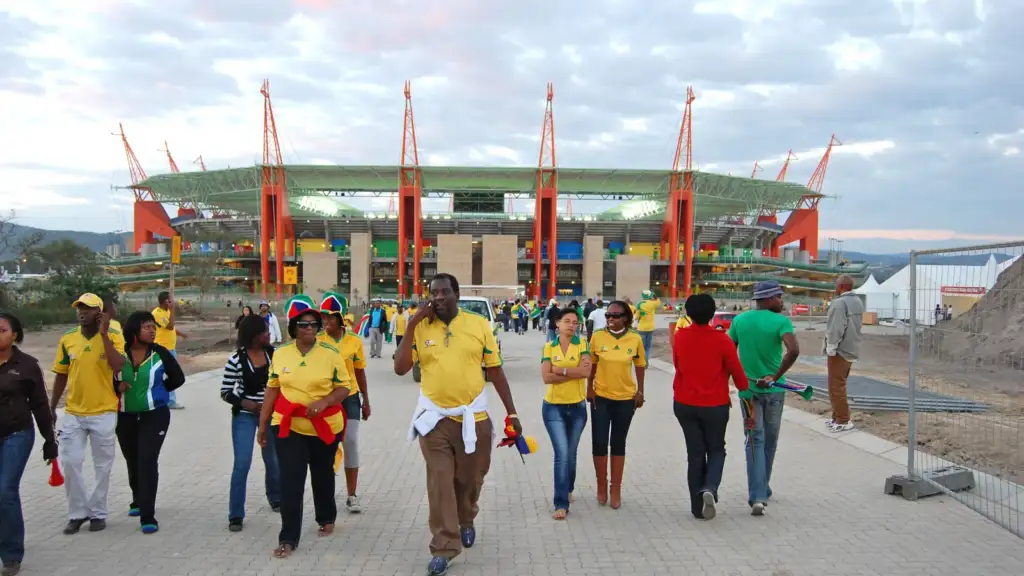
Photo credit: Mbombela Stadium crowd leaving by Tadpolefarm, CC BY-SA 4.0, via Wikimedia Commons.


Join the discussion