
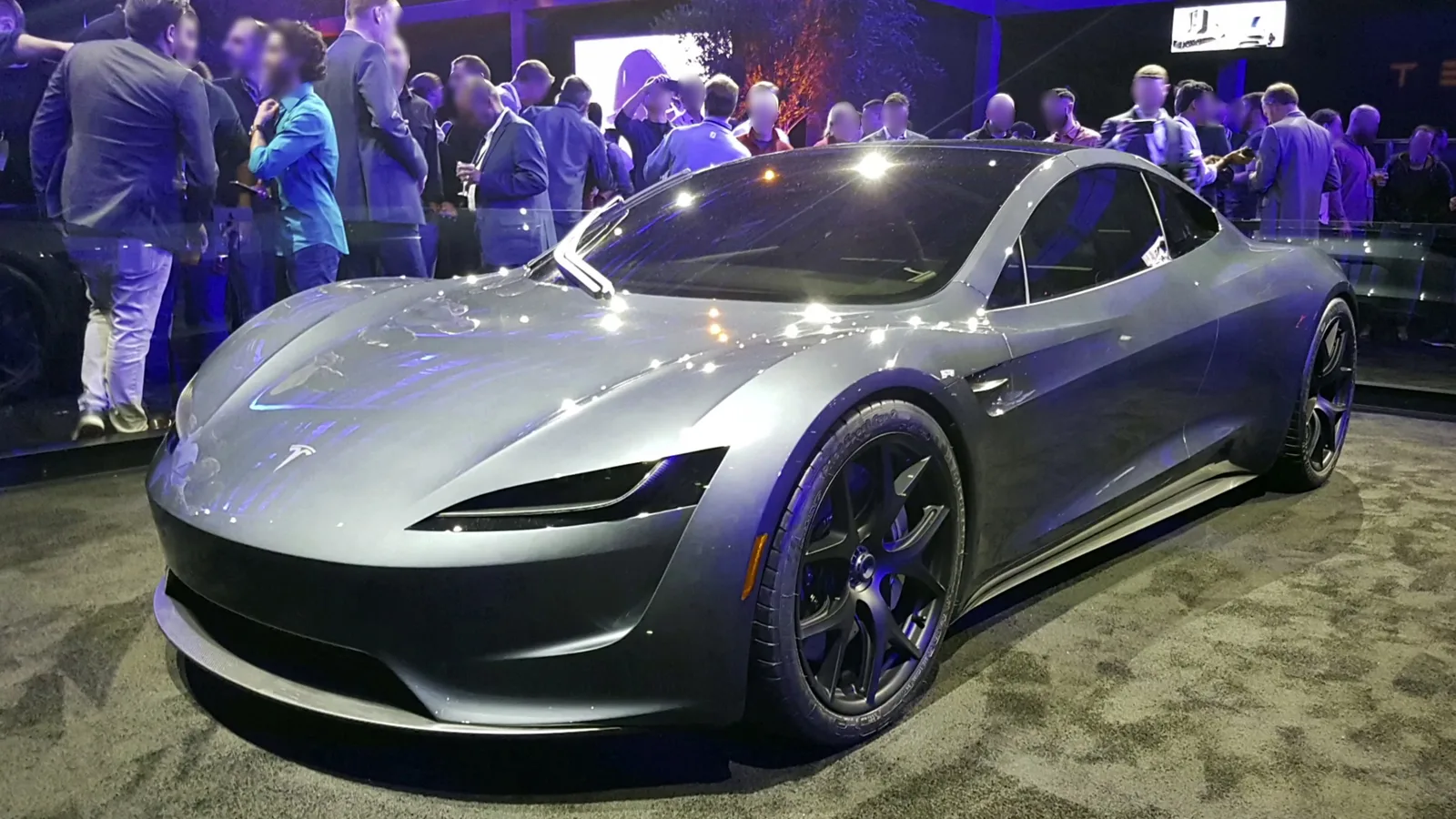
A Tesla flying car jumped into the air in Texas, and the video went everywhere. The car is the new Tesla Roadster. Elon Musk stood on stage and said flying cars are real. So is that true? Sort of. Here are seven facts that explain what actually happened, in plain words.
Updated October 2026. This story is moving quickly, so check the official pages linked at the end before you rely on any detail here.
1. What the Tesla flying car actually did
The Roadster drove up a curved ramp. NBC News says the ramp was shaped like half of a roller coaster loop. The car shot off the end, flew over five other Tesla cars, and landed softly.
Then it did it again. This time it jumped 27 feet into the air, according to Tesla, and rolled right over in a barrel roll before landing on its wheels. After that it drove off fast.
2. How it got off the ground
It does not have wings or helicopter blades. It uses two systems instead.
- Cold gas thrusters. These are small jets that blast compressed air. No fire, no flame, just air pushed out very hard. Tesla says they refill themselves.
- A fan that sucks the car down. Tesla says a fan based suction system pulls the car onto the road so it grips better. Musk joked about it on stage: “This car really sucks.”
CBS News described the propulsion a little differently. It reported Musk saying the car has ultra high pressure air tanks. Both descriptions point at the same idea: stored air, released hard.
3. The FAA says it is not an aircraft
This is the most important fact, and most of the posts you will see leave it out. The Federal Aviation Administration, which is the US government body in charge of flying, told CBS News that the vehicle does not meet its definition of an aircraft.
So in legal terms, it is a car that jumps. A very impressive jump, but a jump. Our guide to whether flying cars are real explains where the line sits.
4. The numbers Tesla has published
- 0 to 60 mph in 0.81 seconds. That is Tesla figure, reported by NBC News. It is quicker than any Tesla you can buy today.
- About 300 miles of range on one charge, per Musk.
- 27 feet of height on the barrel roll jump, per Tesla.
There is no official top speed yet. Musk said he wants the car to reach about halfway to the speed of sound, which NBC put at roughly 383 mph. That is a wish, not a specification.
5. There are three versions, and only one flies
Tesla has described three versions of the car:
- Performance. The normal road car. It gets the suction fan but not the thrusters.
- Thrust. Adds thrusters at the back for harder acceleration.
- Rocket. The one that does the stunts, with thrusters around the car. It is invite only, and it seats one person.
Reports disagree about money, so treat deposit figures carefully. NBC News reported a $50,000 deposit for the base car. CBS News reported $5,000 for a non flying model. That is a ten times difference, and Tesla page could not be checked automatically, so we are not going to pick one for you. CBS also says full prices were simply not announced.
6. You cannot use the flying part on the road
Tesla own website says the Rocket version is not approved for public roads, according to both NBC and CBS. CBS also reported that it was not clear which government agency would even be in charge of it.
Musk himself was honest about the risk. After the stunt worked he said, “Well, it worked!” and then added that “it is not necessarily a safety optimized car.” Before the jump he had said success “is not guaranteed” but “it will probably work.”
7. It is not on sale yet, and Tesla has missed dates before
Production is planned for 2028. That is the part worth remembering. This Roadster was first shown in 2017, and Musk originally promised production in 2020. That did not happen, and the company kept taking reservations in the meantime.
So the honest summary is this. The jump was real and it was filmed live. The car is not an aircraft, it is not for sale, it is not road legal in flying form, and the build date is two years away. For the full specification picture, see our guide to the Tesla Roadster flying car.
How to judge a Tesla flying car video yourself
There will be more clips like this, from Tesla and from other companies. Three quick questions sort a real step forward from a good stunt, and you can ask them in the time it takes to watch.
- Did it go somewhere, or just up and down? Travelling through the air to a different place is flight. Going up and landing in roughly the same spot is a jump.
- How long was it off the ground? Count the seconds. Stunts last two or three. Real flight lasts minutes.
- Who signed it off? If no aviation regulator is mentioned anywhere, the machine is not approved to carry anyone through the air.
Run those three questions over this event and you get a fair picture. It went up and came down, it was airborne for seconds, and the FAA says it is not an aircraft. That is a genuinely impressive piece of engineering and not a flying car in the way the word is normally used.
Why people wanted this story to be true
It is worth noticing why this spread so fast. The flying car has been promised for about a century, so the phrase carries a lot of hope. When a video shows a car in mid air, the brain fills in the rest.
There is no need to be cynical about it. The engineering is real, and SpaceX knowledge of pressurised tanks and thrusters clearly went into it. Just keep the claim the same size as the evidence.
What the jump proves, and what it does not
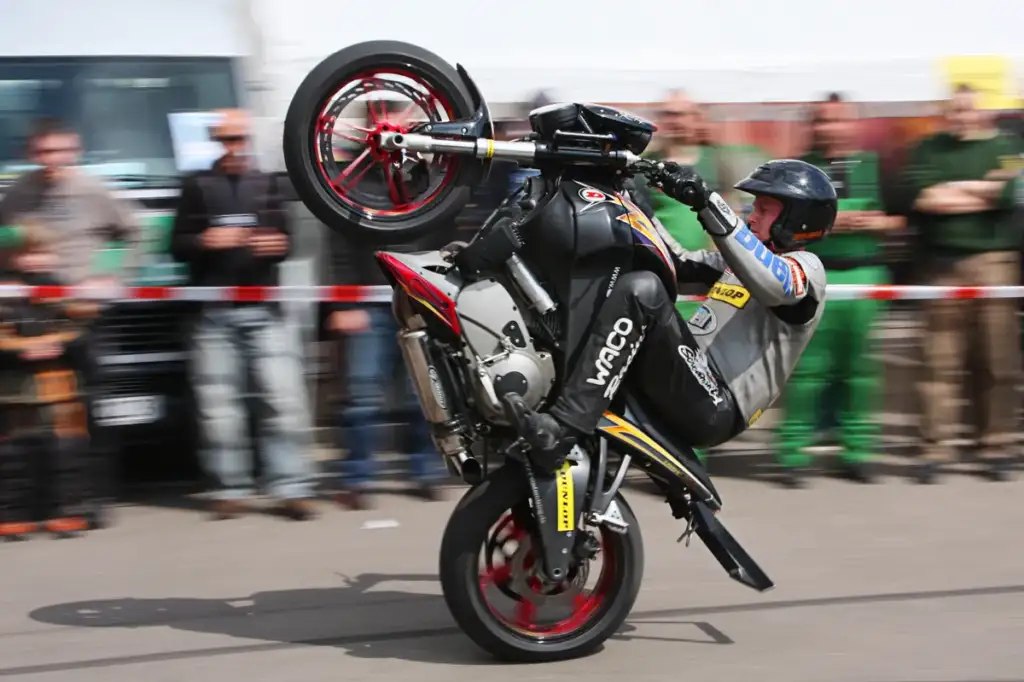
It helps to separate two different things a machine can do in the air. One is a jump. The other is flight. They look similar in a short video and they are not the same.
A jump is what happens when something is pushed hard once and then follows the arc that gravity gives it. A thrown ball does this. So does a motorcycle leaving a ramp. The path is decided at the moment of the push, and the only job left is landing. Flight is different. A flying machine keeps producing lift the whole time it is up there, which is why it can go somewhere, turn around, hover or come back.
By that test, the Roadster jumped. A ramp and a burst of compressed air set it on an arc, the thrusters steadied it, and it came down. That is genuinely difficult engineering. Landing a heavy car softly on its wheels after a barrel roll is not a trick you get right by accident. But it did not travel anywhere, and it could not have stayed up.
This is also why the FAA position makes sense rather than sounding like red tape. Its definition of an aircraft, in the rulebook at 14 CFR 1.1, turns on a device intended for flight in the air. A car that leaves the ground briefly on a ballistic arc does not clear that bar.
Why cold gas is an unusual choice
Most things that push themselves around burn fuel. A cold gas thruster does not. It stores gas under very high pressure and lets it out through a nozzle. The gas rushing out one way pushes the vehicle the other way. Nothing ignites, which is where the word cold comes from.
Spacecraft have used this for decades, because it is simple and controllable. There is no combustion to go wrong, the thrust can be switched on and off very quickly, and the exhaust is just gas. Those properties are useful for small nudges and precise attitude changes, which is close to what a car needs when it is trying to land flat rather than on its nose.
The catch is energy. Compressed gas stores far less energy for its weight than fuel does, so cold gas is good for short, sharp corrections and poor for sustained lift. That is a physical limit rather than a Tesla limit, and it is one reason to be careful with the word flying. The same choice that makes the landing controllable also makes long flight impractical.
Tesla says the thrusters refill themselves, which matters for whether this is a party trick you can do once or a feature you could use repeatedly. How many jumps you get between refills has not been published.
Who would actually have to approve this
Here is the part that decides whether anyone ever uses the flying version on a public road, and it is messier than it sounds. Cars and aircraft are regulated by different bodies, and a machine that does both does not fit either box.
- NHTSA oversees vehicles in the United States. CBS News reports that it typically delegates safety certification to the manufacturer, and that it did not immediately respond to a request for comment on the Roadster.
- The FAA oversees aircraft. It told CBS News this vehicle does not meet its definition of an aircraft, which means it is not currently its problem either.
- Nobody obvious in between. CBS reported that it was not immediately clear which agency would have oversight, and that a senior Transportation Department official was sceptical the vehicle would really take off while acknowledging there was no clear answer.
That gap is the real obstacle, and it is worth understanding because it will not be solved by better engineering. Someone has to decide which rulebook applies, write the test a machine like this has to pass, and then test one. None of that has started in public.
Why the 2028 date matters more than the video
The stunt is the part that spreads. The date is the part that tells you what to expect. Musk said production begins in 2028, and Tesla has not announced a price.
Put that next to the history. This Roadster was first shown in 2017 with production promised for 2020. That did not happen, and the company kept taking reservations through the delay. NBC News also notes that the roughly 300 mile range Musk gave is less than half what was promised when the car was announced.
None of that means 2028 is wrong. It means a date from this company, for this particular car, has been wrong before, and that is useful information if you are thinking about putting money down. Treat it as a target rather than a delivery slot, and read the reservation terms yourself.
A century of flying car promises
The Tesla flying car is the newest entry in a very long list. Knowing the list helps, because almost every pattern in the 2026 coverage has happened before.
Working machines that both drove and flew were built in the 1930s and 1940s. Some genuinely flew. A few were close to production. None ever sold in meaningful numbers, and the reason was always the same trade off rather than a lack of cleverness.
A good car is heavy, low and strong, because it has to survive being hit. A good aircraft is light and wide, because it has to be lifted. Build one machine to do both and you get something mediocre at each, expensive to buy and expensive to maintain, needing both a driving licence and a pilot licence.
Electric motors change part of that. They are light, they can be placed anywhere, and they allow many small propellers rather than one big engine. What they do not change is the weight of the battery, or the fact that a failure in the air is unforgiving in a way a breakdown on a road is not.
What would make the next demonstration more impressive
If Tesla or anyone else shows another video, a few things would represent real progress rather than a bigger version of the same stunt.
- Time off the ground. Seconds is a jump. Minutes would be genuinely new.
- Going somewhere. Taking off in one place and landing in another, deliberately, is the line between a jump and flight.
- Doing it twice in a row. Repeatability tells you about the gas supply and the hardware, not just the single best take.
- An outside observer. A regulator, an independent engineer or a published test report carries more weight than a livestream.
- Carrying a passenger. The Rocket version seats one, which tells you weight is tight.
None of that diminishes what was shown. Landing a car softly after a barrel roll is hard. It simply means the gap between this and transport is wider than the word flying suggests.
How to talk about the Tesla flying car accurately
If you end up explaining this to someone, three sentences cover it honestly without either sneering or overclaiming.
It really happened and it was livestreamed, so the video is not fake. It jumped rather than flew, and the FAA has said it does not meet the definition of an aircraft. It is not for sale, production is set for 2028, and the version that does the stunts is invite only and not approved for public roads.
That is the whole story, and it is more interesting than either the hype or the dismissal. A car company borrowing rocket hardware to land a vehicle on its wheels is a real engineering achievement. It is just not the thing the phrase flying car makes people picture, and the distance between those two is where most of the argument about the Tesla flying car comes from.
One last point of context. The Tesla flying car arrived in the same week as a string of other announcements, and attention is a finite resource. A spectacular ten second clip will always travel further than a regulatory filing, which is exactly why the slower facts, the 2028 date, the missing price and the FAA position, are the ones worth carrying away from it.
The Tesla flying car, boiled down
Everything above, in five lines.
- It really jumped, on a livestream, using blasts of stored compressed air.
- It went up and came down. The FAA says it does not meet the definition of an aircraft.
- Published figures: 0.81 seconds to 60 mph, around 300 miles of range, a 27 foot jump.
- The flying version is invite only and not approved for public roads.
- Production is targeted for 2028, on a car first shown in 2017 with a 2020 promise.
Common questions
Is the Tesla flying car real? The jump is real and was livestreamed. But the FAA told CBS News the vehicle does not meet its definition of an aircraft, so it is a car that leaves the ground, not a plane.
How high did it jump? Tesla says 27 feet on the barrel roll jump. On the first stunt it cleared five Tesla cars.
How does it fly without wings? Cold gas thrusters, which blast stored compressed air. Tesla also uses a fan that sucks the car down onto the road when driving.
When can I buy one? Musk said production starts in 2028. No full price has been announced.
Can I legally fly it? No. Tesla own site says the Rocket version is not approved for public roads.
Sources and further reading
Where the figures and rules above come from, so you can check them:
- The ramp, the five cars, the 27 foot jump and the 0.81 second sprint: NBC News
- The quotes from the event, and what the FAA said about it: CBS News
- Tesla own page for the car, where reservations are taken: Tesla, Roadster
- The legal definition of an aircraft in the United States: eCFR, 14 CFR 1.1
Photo credits: Tesla roadster 2020 prototype by Smnt, CC BY-SA 4.0, via Wikimedia Commons. Tesla Showroom Dadeland Mall, 27 November 2023 – Red car by Phillip Pessar, CC BY 2.0, via Wikimedia Commons. SpaceX Starship SN8 launch as viewed from South Padre Island by Forest Katsch, CC BY-SA 4.0, via Wikimedia Commons. Motor cycle stunt2 amk by User:AngMoKio, CC BY-SA 2.5, via Wikimedia Commons. Hyundai car assembly line by User: Anonyme, CC BY 2.5, via Wikimedia Commons.



Join the discussion